Classroom example Global Power Technologies
Show your class · 1 of 5
The questionShow your class · 2 of 5
How it worksShow your class · 3 of 5
Who does this workShow your class · 4 of 5
Ways inShow your class · 5 of 5
Ask the classFor you
About Global Power TechnologiesFor you
SourcesHow can a temperature difference produce electricity without a spinning turbine?
Global Power Technologies · Company explicitly identifies manufacturing locations in Calgary and Bassano; preserve the distinction.
Where it fits
Pick your class- Science 10 · Unit B, outcome 3 — energy transformations and efficiency
How it works
Schematic · not to scale
Some remote equipment needs electricity where a power line is not available.

A remote device needs a dependable supply of electrical energy.
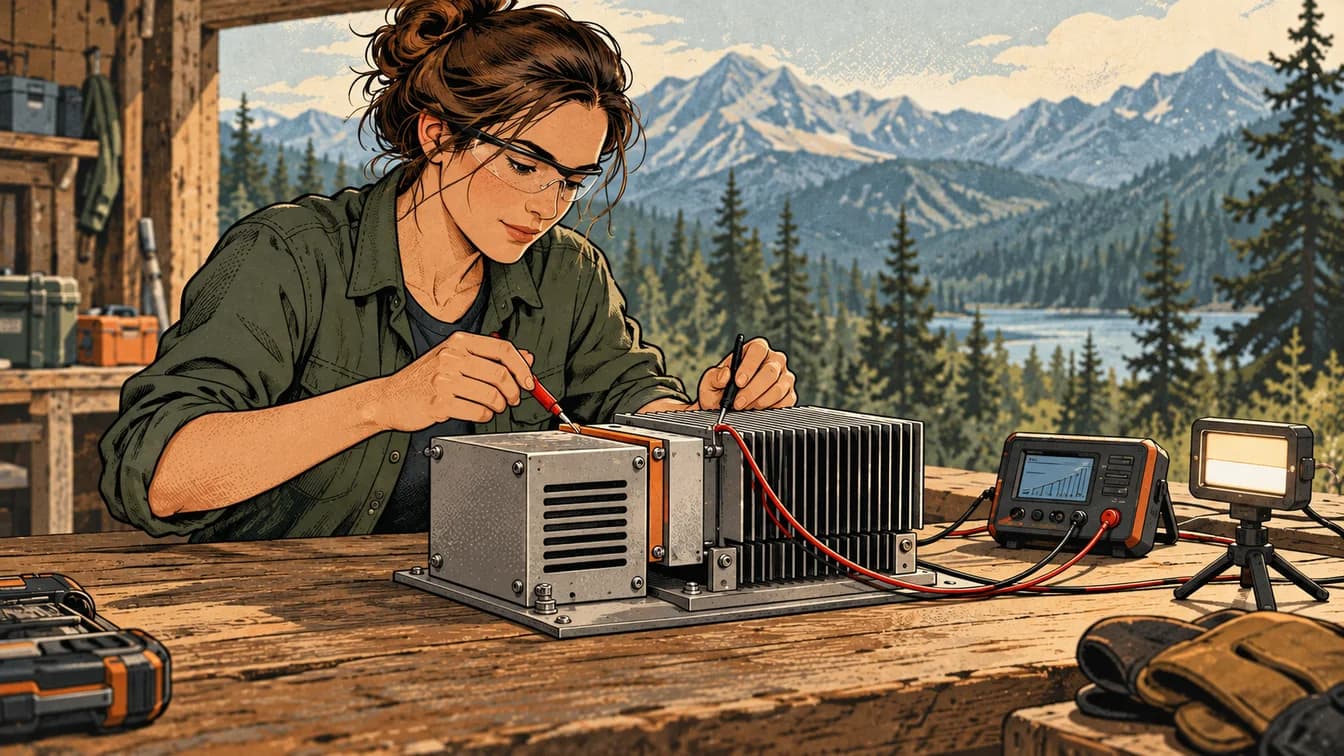
In the company's described thermoelectric system, a burner supplies heat to a hot side while cooling maintains a lower temperature on the other side.
That temperature difference supports a voltage across thermoelectric elements; an attached circuit can supply DC power to a load.
Only part of the supplied energy becomes useful electrical output. The rest must still be accounted for, including heat released to the surroundings.
The Seebeck effect is an extension. Keep the core lesson on energy conversion and constraints. These systems use an energy source; 'no moving parts' does not mean free energy, no fuel or no emissions.
The lesson, in the real world
Some remote equipment needs electricity where a power line is not available.
- 1
A remote device needs a dependable supply of electrical energy.
Our explanation - 2
In the company's described thermoelectric system, a burner supplies heat to a hot side while cooling maintains a lower temperature on the other side.
Our explanation - 3
That temperature difference supports a voltage across thermoelectric elements; an attached circuit can supply DC power to a load.
Our explanation - 4
Only part of the supplied energy becomes useful electrical output. The rest must still be accounted for, including heat released to the surroundings.
Our explanation
Who does this work
Roles connected to this example
What each kind of work involves, the job titles to look for, and where to find postings in Calgary.
Mechanical design and prototyping
Translate a need into a component or machine that can be built and tested. Designers use dimensions, material properties and constraints to evaluate alternatives.
Classroom connection
Geometry, forces and material properties shape real design trade-offs.Job titles to search
Mechanical designer · Mechanical engineerRelated work inferred from thermoelectric products and manufacturing sources; not verified staff titles.Instrumentation and controls
Keep a process measurable and responsive. Controls work connects sensors, decisions and actuators so the system can respond when conditions change.
Classroom connection
Feedback uses a measured result to inform the next action.Job titles to search
Instrumentation technician · Controls technician · Controls engineerRelated work inferred from thermoelectric products and manufacturing sources; not verified staff titles.Manufacturing and quality work
Make repeatable components and check that the output matches a specification.
Classroom connection
Precision, tolerances and repeatable methods connect measurement to useful products.Job titles to search
Manufacturing technician · Production operatorRelated work inferred from thermoelectric products and manufacturing sources; not verified staff titles.
Cards distinguish work documented at Global Power Technologies from related work at other employers. Dated accounts and postings are not a current staff roster or a promise of a vacancy.
Ways in
For your students
Ways to prepare for this work
Programs that teach skills this work uses. Each is one route in, not a requirement, and no program has endorsed this page.
SAITDiplomaCalgary
Mechanical Engineering Technology
Design, modelling and mechanical-system analysis.
About this route
A technical route; does not itself confer professional engineer registration. Check current admissions and intake before applying; this draft does not promise entry or employment.
Why it connects to the work · our interpretation
Mechanical design and prototypingDesign, modelling and mechanical-system analysis. A model is useful when its assumptions are clear and measurements can challenge it.
Manufacturing and quality workDesign, modelling and mechanical-system analysis. Precision, tolerances and repeatable methods connect measurement to useful products.
Instrumentation and controlsDesign, modelling and mechanical-system analysis. A reading depends on where and how it was measured, not just the number displayed.
SAITDiplomaCalgary
Instrumentation Engineering Technology
Measurement, calibration and process controls.
About this route
Related to sensor/control work; no guaranteed employer placement. Check current admissions and intake before applying; this draft does not promise entry or employment.
Why it connects to the work · our interpretation
Instrumentation and controlsMeasurement, calibration and process controls. A reading depends on where and how it was measured, not just the number displayed.
Ask the class
Use it in class
Ask the class
Why would cooling matter in a machine whose purpose is to use heat?
Draw an illustrative energy account with 100 units supplied, 6 units delivered electrically and 94 units transferred elsewhere. Calculate the model efficiency, then explain why these invented values cannot be presented as a product rating. Mark the hot and cool sides and the separate electrical circuit.
Mindset it shows
The Seebeck effect is an extension. Keep the core lesson on energy conversion and constraints. These systems use an energy source; 'no moving parts' does not mean free energy, no fuel or no emissions.
About Global Power Technologies

Some remote equipment needs electricity where a power line is not available.
- Headquarters
- Headquarters not separately verified for this example.
- Local connection
- Company explicitly identifies manufacturing locations in Calgary and Bassano; preserve the distinction.
- Source: globalte.com — official website(opens in a new tab); globalte.com — safety at gpt(opens in a new tab); globalte.com — the importance of fire drills(opens in a new tab); globalte.com — tegs explained solid state remote power for sites that cant afford downtime(opens in a new tab); globalte.com — careers(opens in a new tab)
- Team size
- Not verified. We have not found a dated, sourced figure.
- The problem
- How can a temperature difference produce electricity without a spinning turbine?
- Source: globalte.com — official website(opens in a new tab); globalte.com — safety at gpt(opens in a new tab); globalte.com — the importance of fire drills(opens in a new tab); globalte.com — tegs explained solid state remote power for sites that cant afford downtime(opens in a new tab); globalte.com — careers(opens in a new tab)
- What they do
- Build remote power systems including thermoelectric generators.
- Source: globalte.com — official website(opens in a new tab); globalte.com — safety at gpt(opens in a new tab); globalte.com — the importance of fire drills(opens in a new tab); globalte.com — tegs explained solid state remote power for sites that cant afford downtime(opens in a new tab); globalte.com — careers(opens in a new tab)
- Who uses it
- Operators of remote monitoring, communications and other low-power infrastructure.
- Source: globalte.com — official website(opens in a new tab); globalte.com — safety at gpt(opens in a new tab); globalte.com — the importance of fire drills(opens in a new tab); globalte.com — tegs explained solid state remote power for sites that cant afford downtime(opens in a new tab); globalte.com — careers(opens in a new tab)
Global Power Technologies designs remote power systems, including thermoelectric generators. Its own accounts identify manufacturing locations in Calgary and Bassano, and its current product explanation describes fuel-generated heat producing a temperature difference across thermoelectric elements. This example focuses on heat becoming electrical energy without a rotating turbine, while keeping the two Alberta locations distinct.
Source: globalte.com — official website(opens in a new tab); globalte.com — safety at gpt(opens in a new tab); globalte.com — the importance of fire drills(opens in a new tab); globalte.com — tegs explained solid state remote power for sites that cant afford downtime(opens in a new tab); globalte.com — careers(opens in a new tab)Read each source’s date and scope: a documented role is not proof of a current vacancy or of where every position is based.
Reported as Global Power Technologies states it. Global Power Technologies has not reviewed or endorsed this page.
Sources and course fit
Sources checked 18 Oct 2026
Where it fits
- Science 10 · Unit B, outcome 3 — energy transformations and efficiency
Editorial mapping to published CBE course topics. Pending educator review. No outcome-code alignment is claimed.
Sources
- globalte.com — official website(opens in a new tab)
- globalte.com — safety at gpt(opens in a new tab)
- globalte.com — the importance of fire drills(opens in a new tab)
- globalte.com — tegs explained solid state remote power for sites that cant afford downtime(opens in a new tab)
- globalte.com — careers(opens in a new tab)
- SAIT — Mechanical Engineering Technology(opens in a new tab)
- SAIT — Instrumentation Engineering Technology(opens in a new tab)
- education.alberta.ca — science10.pdf(opens in a new tab)
Organization claims are reported as the organization states them. Global Power Technologies has not reviewed or endorsed this page.
What we know, and how
| Type | Claim | How we know |
|---|---|---|
| work | Global Power Technologies designs remote power systems, including thermoelectric generators. Its own accounts identify manufacturing locations in Calgary and Bassano, and its current product explanation describes fuel-generated heat producing a temperature difference across thermoelectric elements. This example focuses on heat becoming electrical energy without a rotating turbine, while keeping the two Alberta locations distinct.Source: globalte.com — official website; globalte.com — safety at gpt; globalte.com — the importance of fire drills; globalte.com — tegs explained solid state remote power for sites that cant afford downtime; globalte.com — careers | Company-stated work with source limits preserved |
| local connection | Company explicitly identifies manufacturing locations in Calgary and Bassano; preserve the distinction.Source: globalte.com — official website; globalte.com — safety at gpt; globalte.com — the importance of fire drills; globalte.com — tegs explained solid state remote power for sites that cant afford downtime; globalte.com — careers | Source-backed Calgary connection |
| course fit | Direct connection to qualitative energy transformations and efficiency in technological systems. Thermoelectric materials and microscopic carrier behaviour go beyond the required model.Source: education.alberta.ca — science10.pdf | Editorial application of source-checked curriculum concepts |
| limits | Plant-location accounts are dated 2023/2024; individual production stages have not been assigned to one plant. No product-specific efficiency or output is claimed.Source: globalte.com — official website; globalte.com — safety at gpt; globalte.com — the importance of fire drills; globalte.com — tegs explained solid state remote power for sites that cant afford downtime; globalte.com — careers | Scope of this example |
Solid green: the organization states it. Outlined: seen in a dated source. Dashed: our interpretation, not yet researched, or announced but not yet real.