Careers in the Classroom
Back to companies

Classroom example Wilder Institute

Show your class · 1 of 5

The question

Show your class · 2 of 5

How it works

Show your class · 3 of 5

Who does this work

Show your class · 4 of 5

Ways in

Show your class · 5 of 5

Ask the class

For you

About Wilder Institute

For you

Sources

Can helping individual owls help a population recover?

Wilder Institute · Connected to the Calgary Zoo. Field program in southeastern Alberta.

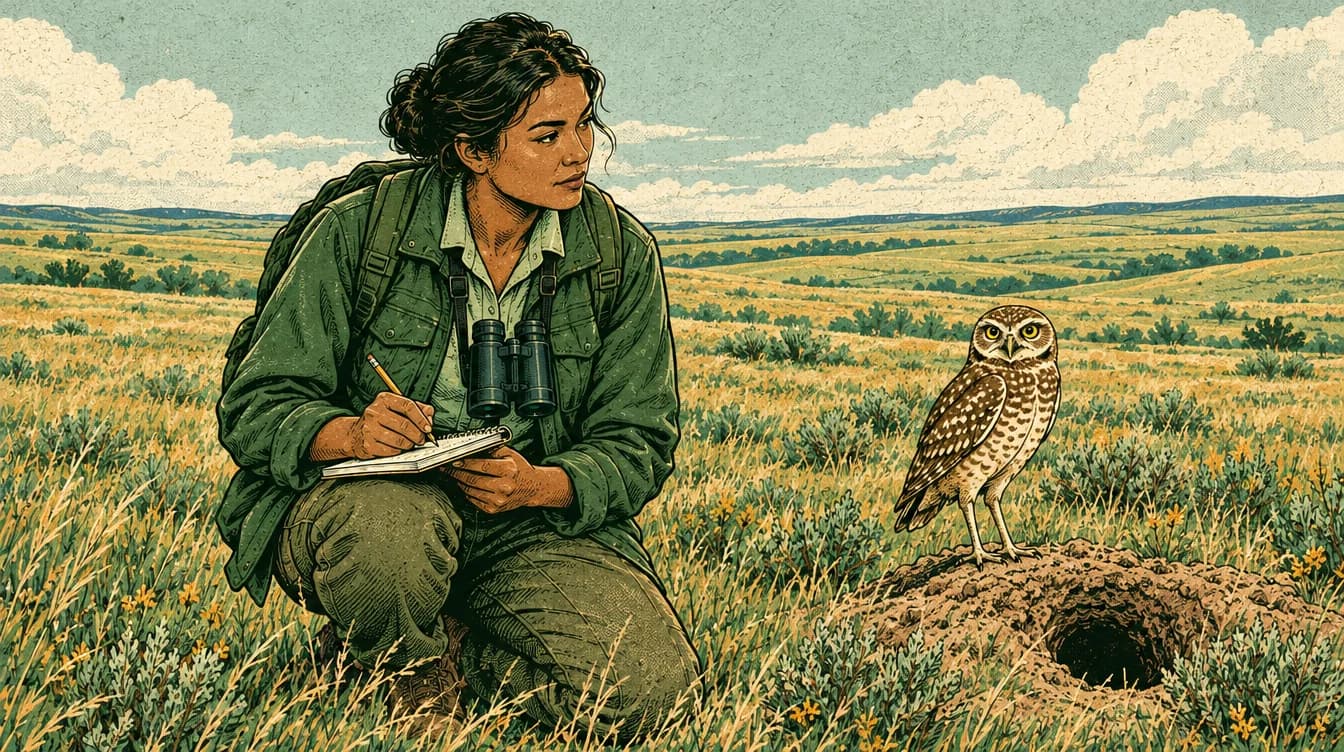
Graphic-novel illustration of a field ecologist recording observations of a burrowing owl beside its burrow on the prairie.

Where it fits

Pick your class
  • Biology 20 · Ecosystems and population change
  • Biology 30 · Population and community dynamics

How it works

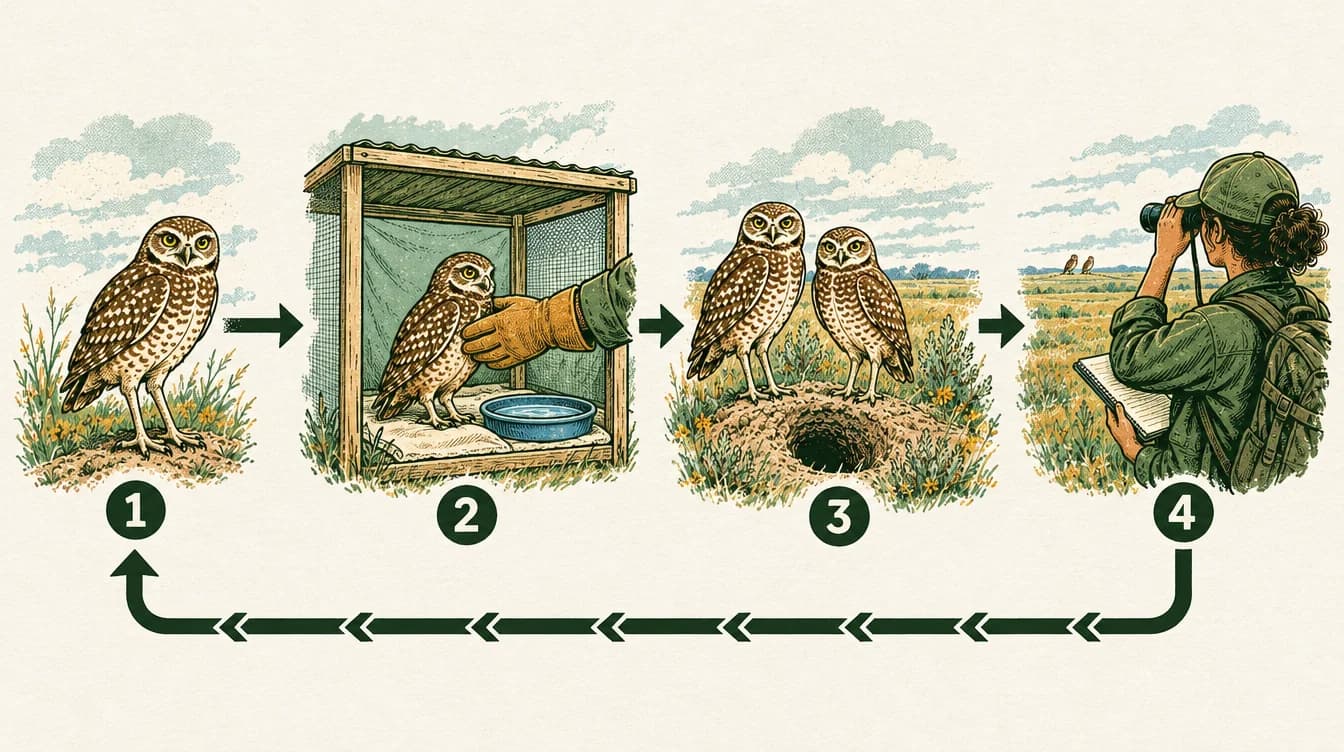
Schematic · not to scale

From care to evidence

A four-stage conservation sequence: vulnerable young owls, winter care, spring release in pairs, then monitoring survival and breeding. A feedback arrow returns evidence to future care and release decisions. Release is not the same as population recovery.
  1. Vulnerable young owls face a difficult early life stage.

  2. Care through winter supports food, welfare and health.

  3. Pairs return to prairie habitat in spring.

  4. Monitor survival, breeding and offspring after release.

The return arrow shows evidence informing the next intervention. A release is a step; recovery is the question.

The lesson, in the real world

Supporting a vulnerable life stage is an intervention. Measuring recovery requires following what happens next.

  1. 1

    Wilder temporarily brings vulnerable young burrowing owls into care through their first winter.

  2. 2

    Animal-care teams provide daily care while veterinarians monitor health and body condition.

  3. 3

    Adults are released in breeding pairs in southeastern Alberta, with supplementary food and monitoring.

  4. 4

    To evaluate recovery, ask about survival and reproduction after release, over time and against a useful comparison. Counting released owls answers only part of that question.

    Our explanation
Source: Wilder Institute: burrowing owl program(opens in a new tab); Wilder Institute: owl care team (2023)(opens in a new tab)

Who does this work

All roles in this example

Role

Animal care and welfare

Support animals day to day and notice changes that matter.

Animal care teams provide food, maintain habitats and observe behaviour and body condition. Care records help the team respond to changes and support conservation work without treating every species as if it has the same needs.

What might you actually do?

  • Provide daily care

    Follow prescribed diets and maintain clean, suitable habitats.

  • Observe and record

    Track behaviour, weight and body condition, and report changes to the team.

  • Work with specialists

    Support veterinary procedures and enrichment under established welfare and safety protocols.

Typical of this kind of work in general. Not a description of any one person’s job at Wilder Institute.

Often works with
VeterinariansConservation researchersAnimal care assistantsFacility staff
Classroom connection
Individual health and behaviour influence survival. Daily observations provide evidence, while population outcomes require follow-up beyond care.

Related job postings

Similar work at other employers in Calgary, AB, not openings at Wilder Institute. These are live searches: results change daily and we have not checked them.

Saved job examples

How employers have described this kind of work, saved on the date shown. Employers have not reviewed or endorsed this page.

  • Animal Care Technician (On-Call in Strathmore, AB)Wilder Institute · Archibald Biodiversity Centre near Strathmore, Alberta; not the Calgary zoo site.Historical example
    Employer posting · saved 29 Sep 2026

    Animal Care Technician (On-Call in Strathmore, AB)

    Wilder Institute

    The conservation organization in this classroom example. This role is at its Archibald Biodiversity Centre.

    Source: Wilder Institute: Animal Care Technician (On-Call in Strathmore, AB)(opens in a new tab)
    Location
    Archibald Biodiversity Centre near Strathmore, Alberta; not the Calgary zoo site.
    Work arrangement
    Fixed-term, on-call; 0–40 hours per week, with a stated contract end of March 2027.
    Experience
    Requires at least two years of animal-care experience at an accredited zoo or aquarium, plus a relevant degree or combination of education and experience.

    Care for conservation-program animals and record evidence about their health and behaviour.

    The work, in our words

    • Provide prescribed diets and monitor animal condition and health.
    • Observe behaviour, maintain animal-care records, and report changes.
    • Maintain habitats and assist with prescribed care and animal-handling procedures.

    Skills the posting asks for

    Animal husbandry · Behaviour observation · Accurate record keeping · Animal welfare and safety

    Classroom connection

    Directly illustrates the daily care and observation work behind conservation programmes.

    What this example establishes: The posting does not identify burrowing owls or assign this job to that project. Applications have an explicit 9 October 2026 deadline.

    Application deadline: 9 Oct 2026

    Application deadline passed (9 Oct 2026) · historical job example

    Employer ADP job description, requisition 1178, deadline, and application entry form inspected. No information entered.

    Original posting(opens in a new tab)

How to prepare

  • Zoology (BSc)

    University of Calgary

  • Veterinary Technical Assistant

    Olds College of Agriculture & Technology

  • Veterinary Technology

    Olds College of Agriculture & Technology

See all pathways

Ways in

For your students

Ways to prepare for this work

Programs that teach skills this work uses. Each is one route in, not a requirement, and no program has endorsed this page.

Showing routes for animal care and welfare. Show all

  • University of CalgaryUniversity degreeCalgary

    Zoology (BSc)

    Study animal structure, function and diversity, with a broad foundation in animal biology.

    About this route

    An undergraduate route. The Wilder job example also asks for animal-care experience; a degree alone does not meet every requirement.

    Why it connects to the work · our interpretation

    Animal care and welfare

    Animal biology helps explain differences in behaviour, body condition and species needs.

  • Olds College of Agriculture & TechnologyFour-month certificateOlds, Alberta

    Veterinary Technical Assistant

    Hands-on animal handling, patient preparation and veterinary equipment for entry-level support work.

    About this route

    An entry-level support route, not a veterinarian qualification or a substitute for the experience in Wilder’s posting.

    Why it connects to the work · our interpretation

    Animal care and welfare

    Provides an introduction to animal-care practice and assisting veterinary teams; wildlife-specific experience still needs to be developed.

  • Olds College of Agriculture & Technology18-month accelerated diplomaOlds, Alberta

    Veterinary Technology

    Animal care, anatomy, diagnostic procedures and clinical skills, including an industry practicum.

    About this route

    This diploma does not provide direct entry to a DVM. Professional registration has additional examination requirements; consult the provider.

    Why it connects to the work · our interpretation

    Animal care and welfare

    Clinical observation and care skills can support work alongside veterinarians. The program trains veterinary technologists, a distinct role from veterinarians.

Ask the class

Use it in class

Ask the class

What would you measure over several years to decide whether this intervention is helping? What comparison would make your conclusion more convincing?

Saving animals and restoring a population are connected but different goals. Scientists need evidence about what happens after release, not just a count of animals cared for.

Mindset it shows

Evaluate outcomes beyond the most visible success metric.

About Wilder Institute

Conservation research and animal care, working together for wildlife.

Headquarters
Calgary, Alberta. Its head office is listed at 1300 Zoo Road NE.
Source: Wilder Institute: offices(opens in a new tab)
Local connection
The Calgary Zoo is part of the organization. Owls spend winter at the Archibald Biodiversity Centre; releases take place in southeastern Alberta. The animal-care job example is near Strathmore.
Source: Wilder Institute: About Wilder(opens in a new tab); Wilder Institute: burrowing owl program(opens in a new tab); Wilder Institute: Animal Care Technician (On-Call in Strathmore, AB)(opens in a new tab)
Team size
Not verified. We have not found a dated, sourced figure.
The problem
At-risk species need support that addresses survival, habitat and the challenges of returning animals to the wild. The burrowing owl program focuses on vulnerable young birds.
Source: Wilder Institute: burrowing owl program(opens in a new tab)
What they do
Conservation breeding, animal care, field research and partnerships to support species recovery.
Source: Wilder Institute: About Wilder(opens in a new tab); Wilder Institute: burrowing owl program(opens in a new tab)
Who benefits
At-risk wildlife and the people and communities working to conserve it. In the owl program, landowners help provide release sites on prairie grasslands.
Source: Wilder Institute: About Wilder(opens in a new tab); Wilder Institute: burrowing owl program(opens in a new tab)

Wilder describes itself as a global conservation charity bringing together conservation, animal care and public engagement. Its work includes the Calgary Zoo and species recovery programs.

Source: Wilder Institute: About Wilder(opens in a new tab)
Who does this work

Read each source’s date and scope: a documented role is not proof of a current vacancy or of where every position is based.

Reported as Wilder Institute states it. Wilder Institute has not reviewed or endorsed this page.

Sources and course fit

Sources checked 24–29 Sep 2026

Where it fits

  • Biology 20 · Ecosystems and population change
  • Biology 30 · Population and community dynamics

Editorial mapping to published CBE course topics. Pending educator review. No outcome-code alignment is claimed.

Organization claims are reported as the organization states them. Wilder Institute has not reviewed or endorsed this page.

What we know, and how
TypeClaimHow we know
workCares for young owls through their first winter, then releases and monitors adult pairs.Source: Burrowing owl programOrganization-stated
rolesPopulation ecologist leads the program. Animal care technicians and vets support it.Source: Researcher interview, Jul 2025; Care team account, 2023Observed · 2025 and 2023
pathwaysEcology, zoology, environmental science.Source: UCalgary science program guidesInferred direction
course fitBiology 20 and Biology 30 population units.Source: CBE Biology 20–30 topicsEditorial · pending review

Solid green: the organization states it. Outlined: seen in a dated source. Dashed: our interpretation, not yet researched, or announced but not yet real.