Classroom example WaterSMART — a Hazen company
Show your class · 1 of 5
The questionShow your class · 2 of 5
How it worksShow your class · 3 of 5
Who does this workShow your class · 4 of 5
Ways inShow your class · 5 of 5
Ask the classFor you
About WaterSMART — a Hazen companyFor you
SourcesHow do you plan water supplies for a city that keeps changing?
WaterSMART — a Hazen company · Calgary-based work is established through the City’s named roadmap partnership and the company team page.

Where it fits
Pick your class- Biology 20 · Water use, conservation and ecosystems
How it works
Schematic · not to scale
Plan for more than one possible future
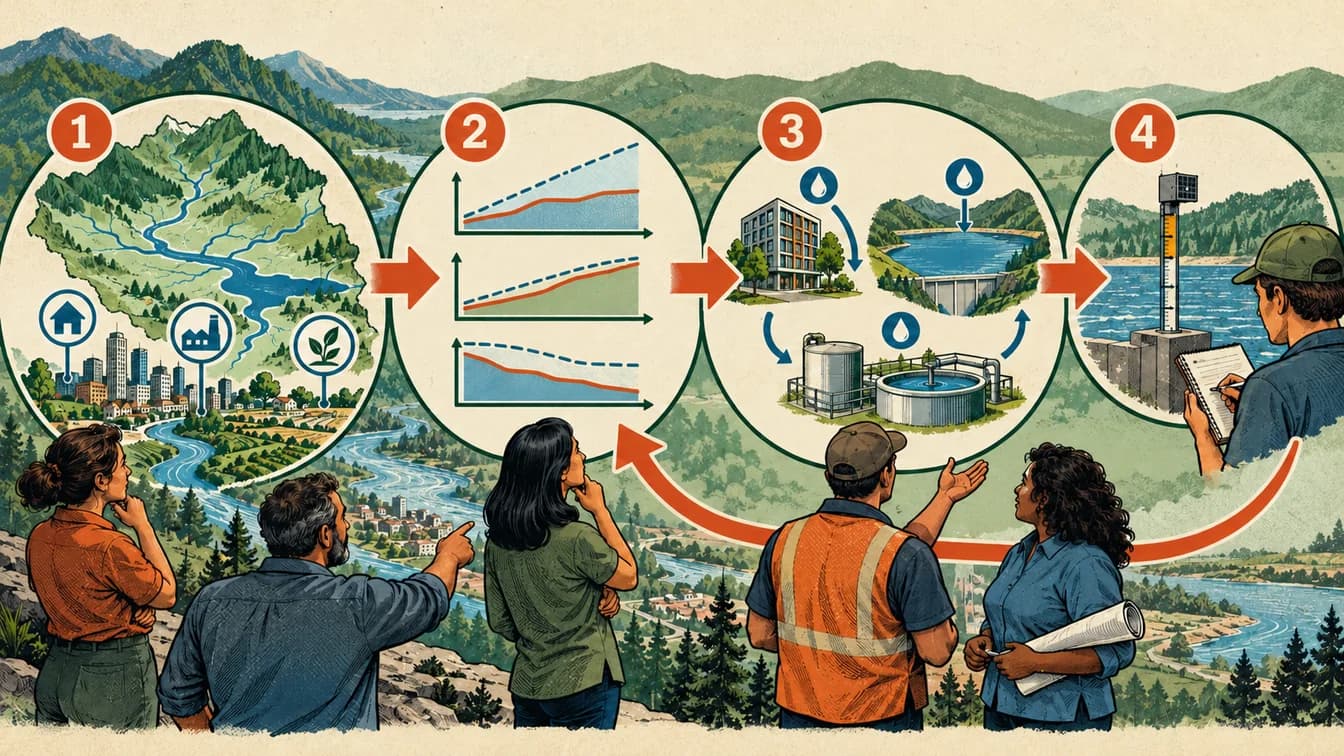
Gather evidence about water sources and uses.
Compare multiple future supply-and-demand scenarios.
Evaluate conservation, treatment and supply options.
Monitor conditions and revise the plan.
The graphs are invented scenarios, not forecasts. Reuse needs treatment appropriate to its intended use; a roadmap is not proof an option is already operating.
The lesson, in the real world
A useful water plan asks what might change, not just how much water is available today.
- 1
Describe the sources and uses of water in the system.
Our explanation - 2
Build more than one scenario for future demand and available supply.
Our explanation - 3
Compare options such as reducing demand or changing which water source serves a use. Reuse requires the right treatment and controls.
Our explanation - 4
Choose actions that can be revised as monitoring and circumstances change. A plan should state uncertainty rather than hide it.
Our explanation
Who does this work
Role
Water-resource planning
Compare water availability, demand and possible responses over time.
What might you actually do?
Investigate
Organize supply, use and monitoring information.
Test and compare
Test alternative assumptions in scenarios.
Document and improve
Explain trade-offs, uncertainty and priorities.
Typical of this kind of work in general. Not a description of any one person’s job at WaterSMART — a Hazen company.
- Often works with
- Hydrologists, engineers, policy specialists and communities
- Classroom connection
- A model is a way to test assumptions, not a guarantee about the future.
Related job postings
Similar work at other employers in Calgary, AB, not openings at WaterSMART — a Hazen company. These are live searches: results change daily and we have not checked them.
- Water resources engineerIndeed search for Water resources engineer (opens in a new tab)Job Bank search for Water resources engineer (opens in a new tab)
- HydrologistIndeed search for Hydrologist (opens in a new tab)Job Bank search for Hydrologist (opens in a new tab)
- Water resources plannerIndeed search for Water resources planner (opens in a new tab)Job Bank search for Water resources planner (opens in a new tab)
How to prepare
Integrated Water Management
SAIT
Civil Engineering
University of Calgary
Ways in
For your students
Ways to prepare for this work
Programs that teach skills this work uses. Each is one route in, not a requirement, and no program has endorsed this page.
Showing routes for water-resource planning. Show all
SAITDiplomaCalgary
Integrated Water Management
Study water systems, monitoring and management.
About this route
Check current admission, portfolio, intake and workplace requirements; program completion does not guarantee a job or professional registration.
Why it connects to the work · our interpretation
Water-resource planningWater sampling, infrastructure and planning support. A model is a way to test assumptions, not a guarantee about the future.
University of CalgaryBachelor’s degreeCalgary
Civil Engineering
Study the design and operation of structures, transportation and water infrastructure.
About this route
Check current admissions and program requirements. A degree is not automatic professional licensure.
Why it connects to the work · our interpretation
Water-resource planningA degree foundation for engineering work; professional registration and supervised experience are separate. A model is a way to test assumptions, not a guarantee about the future.
Ask the class
Use it in class
Ask the class
Would you choose the option that is best in one forecast or useful across several forecasts?
Use fictional annual demand of 100 units. Compare a 10-unit demand reduction under supplies of 120, 100 and 80 units. Identify the remaining deficit and one assumption the arithmetic leaves out.
Mindset it shows
Units are fictional. Real planning includes seasonality, ecosystems, rights, infrastructure and water quality; subtraction alone is not a water-security assessment.
About WaterSMART — a Hazen company

A useful water plan asks what might change, not just how much water is available today.
- Headquarters
- Headquarters not separately verified for this example.
- Local connection
- Calgary-based work is established through the City’s named roadmap partnership and the company team page.
- Source: WaterSMART — a Hazen company — company/project evidence 1(opens in a new tab); WaterSMART — a Hazen company — company/project evidence 2(opens in a new tab); WaterSMART — a Hazen company — company/project evidence 3(opens in a new tab)
- Team size
- Not verified. We have not found a dated, sourced figure.
- The problem
- How do you plan water supplies for a city that keeps changing?
- Source: WaterSMART — a Hazen company — company/project evidence 1(opens in a new tab); WaterSMART — a Hazen company — company/project evidence 2(opens in a new tab); WaterSMART — a Hazen company — company/project evidence 3(opens in a new tab)
- What they do
- Water-management analysis and planning across supply, demand and reuse options.
- Source: WaterSMART — a Hazen company — company/project evidence 1(opens in a new tab); WaterSMART — a Hazen company — company/project evidence 2(opens in a new tab); WaterSMART — a Hazen company — company/project evidence 3(opens in a new tab)
- Who uses it
- Municipal water planners and communities relying on water supplies.
- Source: WaterSMART — a Hazen company — company/project evidence 1(opens in a new tab); WaterSMART — a Hazen company — company/project evidence 2(opens in a new tab); WaterSMART — a Hazen company — company/project evidence 3(opens in a new tab)
WaterSMART, now presented as a Hazen company, works on water management with engineers, environmental scientists and policy specialists. The City of Calgary identifies WaterSMART as a partner in its integrated water-security roadmap and water-reuse assessment. The project supports long-term choices about water supply, demand and reuse; planning evidence does not mean every option has been built.
Source: WaterSMART — a Hazen company — company/project evidence 1(opens in a new tab); WaterSMART — a Hazen company — company/project evidence 2(opens in a new tab); WaterSMART — a Hazen company — company/project evidence 3(opens in a new tab)Read each source’s date and scope: a documented role is not proof of a current vacancy or of where every position is based.
Reported as WaterSMART — a Hazen company states it. WaterSMART — a Hazen company has not reviewed or endorsed this page.
Sources and course fit
Sources checked 17 Oct 2026
Where it fits
- Biology 20 · Water use, conservation and ecosystems
Editorial mapping to published CBE course topics. Pending educator review. No outcome-code alignment is claimed.
Sources
- Alberta Biology 20–30 program: water use and ecosystems(opens in a new tab)
- SAIT — Environmental Technology(opens in a new tab)
- University of Calgary — Civil Engineering(opens in a new tab)
- WaterSMART — a Hazen company — company/project evidence 1(opens in a new tab)
- WaterSMART — a Hazen company — company/project evidence 2(opens in a new tab)
- WaterSMART — a Hazen company — company/project evidence 3(opens in a new tab)
- SAIT — Integrated Water Management(opens in a new tab)
Organization claims are reported as the organization states them. WaterSMART — a Hazen company has not reviewed or endorsed this page.
What we know, and how
| Type | Claim | How we know |
|---|---|---|
| work | WaterSMART, now presented as a Hazen company, works on water management with engineers, environmental scientists and policy specialists. The City of Calgary identifies WaterSMART as a partner in its integrated water-security roadmap and water-reuse assessment. The project supports long-term choices about water supply, demand and reuse; planning evidence does not mean every option has been built.Source: WaterSMART — a Hazen company — company/project evidence 1; WaterSMART — a Hazen company — company/project evidence 2; WaterSMART — a Hazen company — company/project evidence 3 | Source-backed company/project account |
| local connection | Calgary-based work is established through the City’s named roadmap partnership and the company team page.Source: WaterSMART — a Hazen company — company/project evidence 1; WaterSMART — a Hazen company — company/project evidence 2; WaterSMART — a Hazen company — company/project evidence 3 | Source-backed local work |
| course fit | Biology 20 A2.1sts explicitly connects societal water use to ecosystem water quality, quantity, purification and conservation. Compare scenarios rather than treating a forecast as certain.Source: Alberta Biology 20–30 program: water use and ecosystems | Editorial application of verified curriculum topics |
| limits | No claim that reuse water is automatically potable or that roadmap recommendations are already constructed.Source: WaterSMART — a Hazen company — company/project evidence 1; WaterSMART — a Hazen company — company/project evidence 2; WaterSMART — a Hazen company — company/project evidence 3 | Scope of this example |
Solid green: the organization states it. Outlined: seen in a dated source. Dashed: our interpretation, not yet researched, or announced but not yet real.