Classroom example Trace Associates
Show your class · 1 of 5
The questionShow your class · 2 of 5
How it worksShow your class · 3 of 5
Who does this workShow your class · 4 of 5
Ways inShow your class · 5 of 5
Ask the classFor you
About Trace AssociatesFor you
SourcesWhat evidence tells you which contaminated soil needs treatment?
Trace Associates · Calgary headquarters and a Calgary team’s environmental assessment work are documented; the teaching site is fictional.
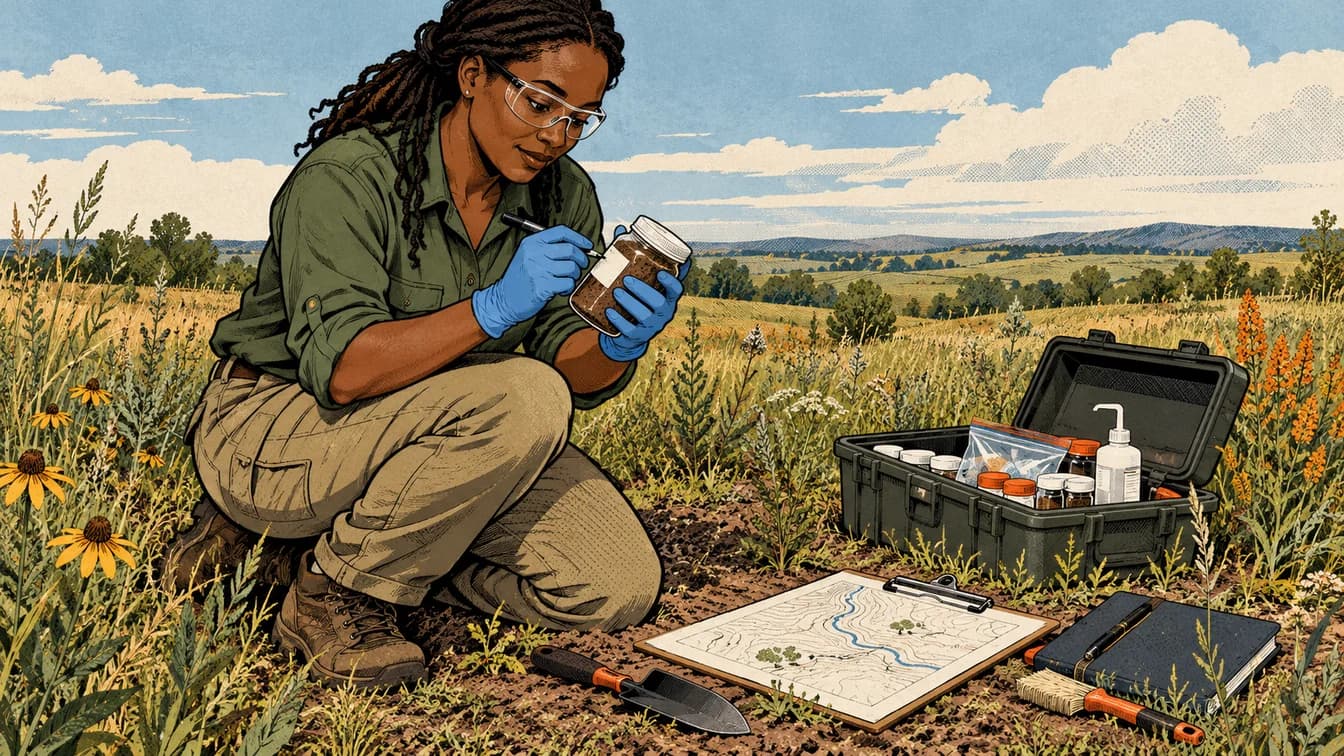
Where it fits
Pick your class- Chemistry 20 · Concentration and representative sampling
How it works
Schematic · not to scale
Turn a site question into testable evidence
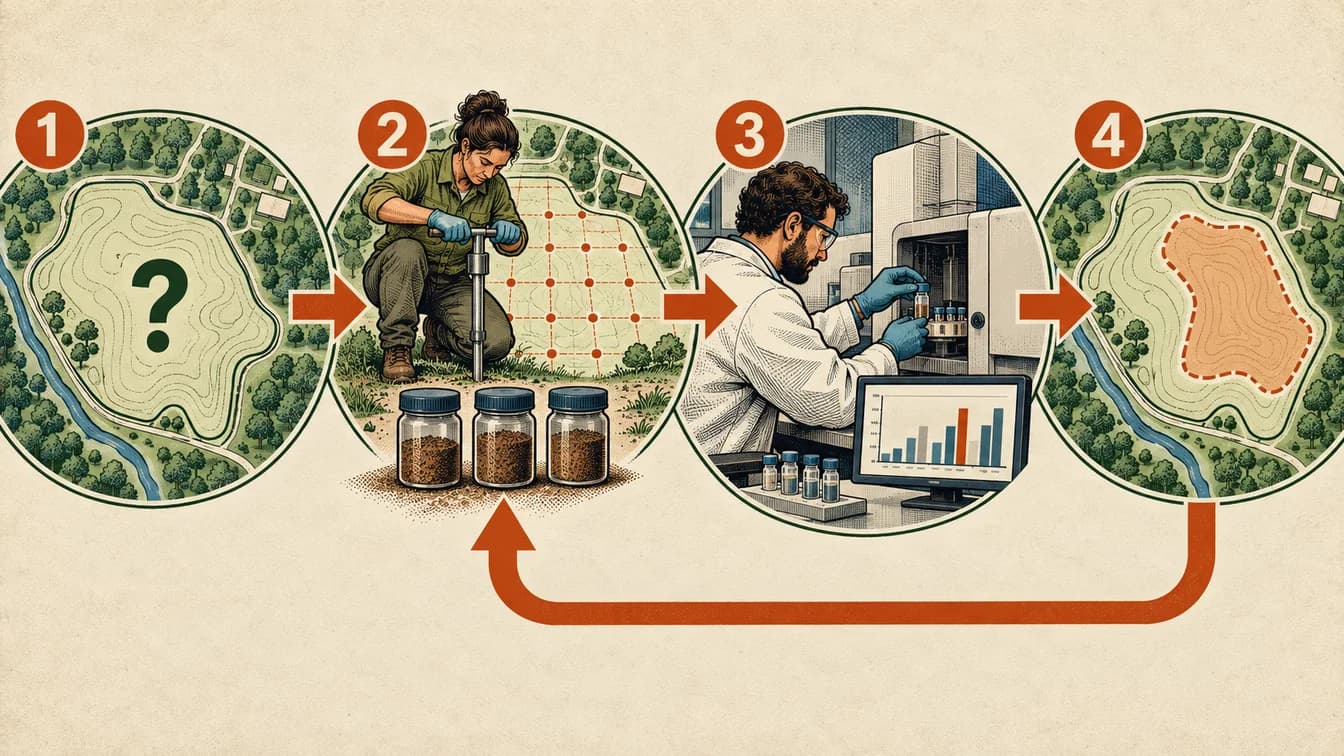
Define the question about the site.
Plan and document where samples are taken.
Interpret laboratory results with the sampling context.
Revise the investigation or response using the evidence.
The map and chart are fictional, not evidence of contamination at a real site. One clean sample does not establish the condition of the whole site.
The lesson, in the real world
A sample answers a question about a place, a depth and a moment in time.
- 1
Define the question and consider how a substance could reach people, water or other organisms.
Our explanation - 2
Choose sampling locations and depths that can test that explanation.
Our explanation - 3
Compare laboratory results with units, detection limits and the sampling plan visible.
Our explanation - 4
Use the evidence to consider treatment, further investigation or monitoring. One clean sample does not describe the whole site.
Our explanation
Who does this work
Role
Water-resource planning
Compare water availability, demand and possible responses over time.
What might you actually do?
Investigate
Organize supply, use and monitoring information.
Test and compare
Test alternative assumptions in scenarios.
Document and improve
Explain trade-offs, uncertainty and priorities.
Typical of this kind of work in general. Not a description of any one person’s job at Trace Associates.
- Often works with
- Hydrologists, engineers, policy specialists and communities
- Classroom connection
- A model is a way to test assumptions, not a guarantee about the future.
Related job postings
Similar work at other employers in Calgary, AB, not openings at Trace Associates. These are live searches: results change daily and we have not checked them.
- Water resources engineerIndeed search for Water resources engineer (opens in a new tab)Job Bank search for Water resources engineer (opens in a new tab)
- HydrologistIndeed search for Hydrologist (opens in a new tab)Job Bank search for Hydrologist (opens in a new tab)
- Water resources plannerIndeed search for Water resources planner (opens in a new tab)Job Bank search for Water resources planner (opens in a new tab)
How to prepare
Integrated Water Management
SAIT
Ways in
For your students
Ways to prepare for this work
Programs that teach skills this work uses. Each is one route in, not a requirement, and no program has endorsed this page.
Showing routes for water-resource planning. Show all
SAITDiplomaCalgary
Integrated Water Management
Study water systems, monitoring and management.
About this route
Check current admission, portfolio, intake and workplace requirements; program completion does not guarantee a job or professional registration.
Why it connects to the work · our interpretation
Water-resource planningWater sampling, infrastructure and planning support. A model is a way to test assumptions, not a guarantee about the future.
Ask the class
Use it in class
Ask the class
How could a sampling plan miss the part of a site that matters most?
Place six sampling points on a fictional site map containing a former storage area and a drainage ditch. Explain why each point helps test a hypothesis and identify one unsampled uncertainty.
Mindset it shows
This is a reasoning activity, not an environmental site-assessment protocol. Do not supply a universal safe concentration or ask learners to handle unknown soil.
About Trace Associates

A sample answers a question about a place, a depth and a moment in time.
- Headquarters
- Headquarters not separately verified for this example.
- Local connection
- Calgary headquarters and a Calgary team’s environmental assessment work are documented; the teaching site is fictional.
- Source: Trace Associates — company/project evidence 1(opens in a new tab); Trace Associates — company/project evidence 2(opens in a new tab); Trace Associates — company/project evidence 3(opens in a new tab); Trace Associates — company/project evidence 4(opens in a new tab)
- Team size
- Not verified. We have not found a dated, sourced figure.
- The problem
- What evidence tells you which contaminated soil needs treatment?
- Source: Trace Associates — company/project evidence 1(opens in a new tab); Trace Associates — company/project evidence 2(opens in a new tab); Trace Associates — company/project evidence 3(opens in a new tab); Trace Associates — company/project evidence 4(opens in a new tab)
- What they do
- Environmental assessment, remediation and risk-management services.
- Source: Trace Associates — company/project evidence 1(opens in a new tab); Trace Associates — company/project evidence 2(opens in a new tab); Trace Associates — company/project evidence 3(opens in a new tab); Trace Associates — company/project evidence 4(opens in a new tab)
- Who uses it
- Landowners, project teams and people affected by decisions about land and water.
- Source: Trace Associates — company/project evidence 1(opens in a new tab); Trace Associates — company/project evidence 2(opens in a new tab); Trace Associates — company/project evidence 3(opens in a new tab); Trace Associates — company/project evidence 4(opens in a new tab)
Trace Associates has its headquarters in Calgary and provides environmental science and engineering services. Its remediation practice describes using site conditions and risk to guide decisions. Conference material by its Calgary division manager documents work involving soil and groundwater investigations. This supports a story about environmental evidence, without attributing a fictional contaminated site to a real Calgary property.
Source: Trace Associates — company/project evidence 1(opens in a new tab); Trace Associates — company/project evidence 2(opens in a new tab); Trace Associates — company/project evidence 3(opens in a new tab); Trace Associates — company/project evidence 4(opens in a new tab)Read each source’s date and scope: a documented role is not proof of a current vacancy or of where every position is based.
Reported as Trace Associates states it. Trace Associates has not reviewed or endorsed this page.
Sources and course fit
Sources checked 17 Oct 2026
Where it fits
- Chemistry 20 · Concentration and representative sampling
Editorial mapping to published CBE course topics. Pending educator review. No outcome-code alignment is claimed.
Sources
- SAIT — Environmental Technology(opens in a new tab)
- SAIT — Chemical Laboratory Technology(opens in a new tab)
- SAIT — Integrated Water Management(opens in a new tab)
- Alberta Chemistry 20–30 program: solutions and concentration(opens in a new tab)
- Trace Associates — company/project evidence 1(opens in a new tab)
- Trace Associates — company/project evidence 2(opens in a new tab)
- Trace Associates — company/project evidence 3(opens in a new tab)
- Trace Associates — company/project evidence 4(opens in a new tab)
Organization claims are reported as the organization states them. Trace Associates has not reviewed or endorsed this page.
What we know, and how
| Type | Claim | How we know |
|---|---|---|
| work | Trace Associates has its headquarters in Calgary and provides environmental science and engineering services. Its remediation practice describes using site conditions and risk to guide decisions. Conference material by its Calgary division manager documents work involving soil and groundwater investigations. This supports a story about environmental evidence, without attributing a fictional contaminated site to a real Calgary property.Source: Trace Associates — company/project evidence 1; Trace Associates — company/project evidence 2; Trace Associates — company/project evidence 3; Trace Associates — company/project evidence 4 | Source-backed company/project account |
| local connection | Calgary headquarters and a Calgary team’s environmental assessment work are documented; the teaching site is fictional.Source: Trace Associates — company/project evidence 1; Trace Associates — company/project evidence 2; Trace Associates — company/project evidence 3; Trace Associates — company/project evidence 4 | Source-backed local work |
| course fit | Chemistry 20 Unit C provides concentration concepts. Compare results with units and a sampling plan; regulatory decisions and toxicology are not classroom safety rules.Source: Alberta Chemistry 20–30 program: solutions and concentration | Editorial application of verified curriculum topics |
| limits | Do not label an actual neighbourhood contaminated. Specific test methods and regulatory decisions remain outside the classroom model.Source: Trace Associates — company/project evidence 1; Trace Associates — company/project evidence 2; Trace Associates — company/project evidence 3; Trace Associates — company/project evidence 4 | Scope of this example |
Solid green: the organization states it. Outlined: seen in a dated source. Dashed: our interpretation, not yet researched, or announced but not yet real.