Classroom example Standen’s (IMT)
Show your class · 1 of 5
The questionShow your class · 2 of 5
How it worksShow your class · 3 of 5
Who does this workShow your class · 4 of 5
Ways inShow your class · 5 of 5
Ask the classFor you
About Standen’s (IMT)For you
SourcesWhy can a steel spring bend repeatedly without staying bent?
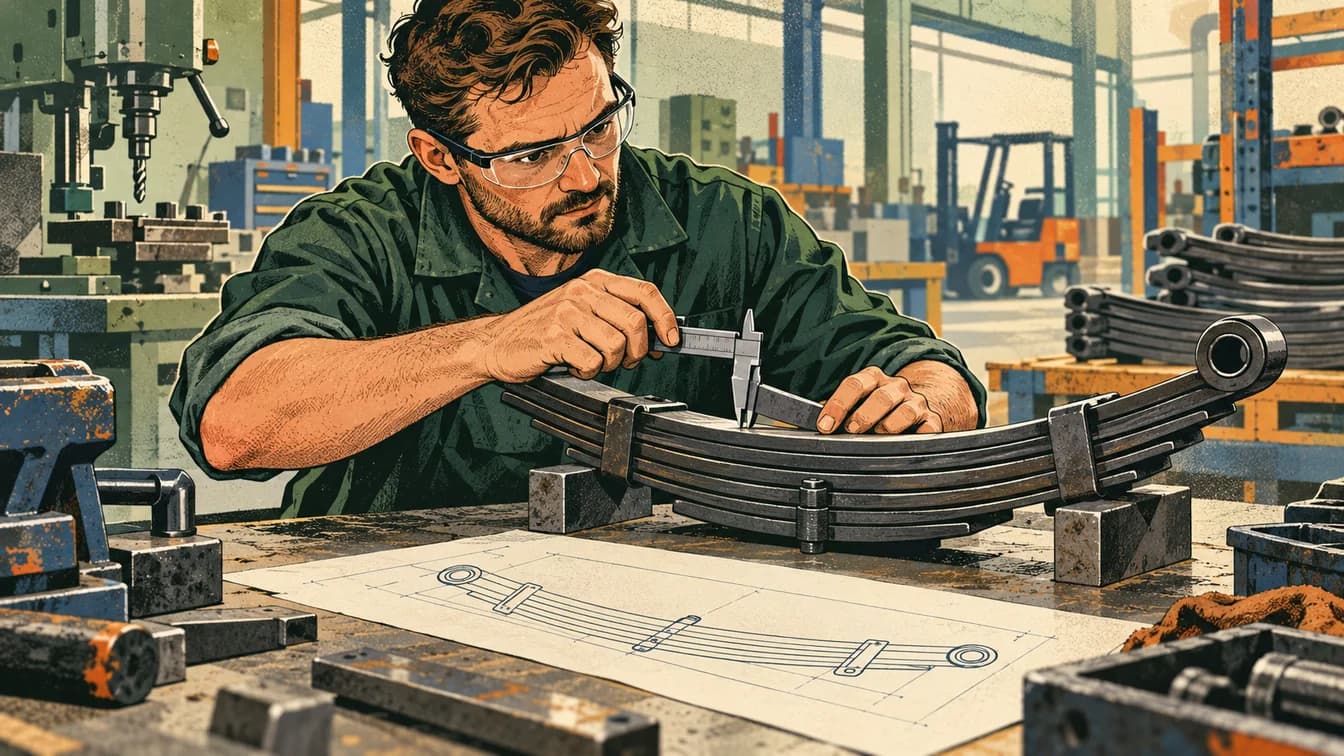
Standen’s (IMT) · Calgary manufacturing facility stated on current company homepage.
Where it fits
Pick your class- Physics 20 · D1 — oscillatory motion and restoring force
How it works
Schematic · not to scale
A spring has to move under a load and still be ready for the next one.
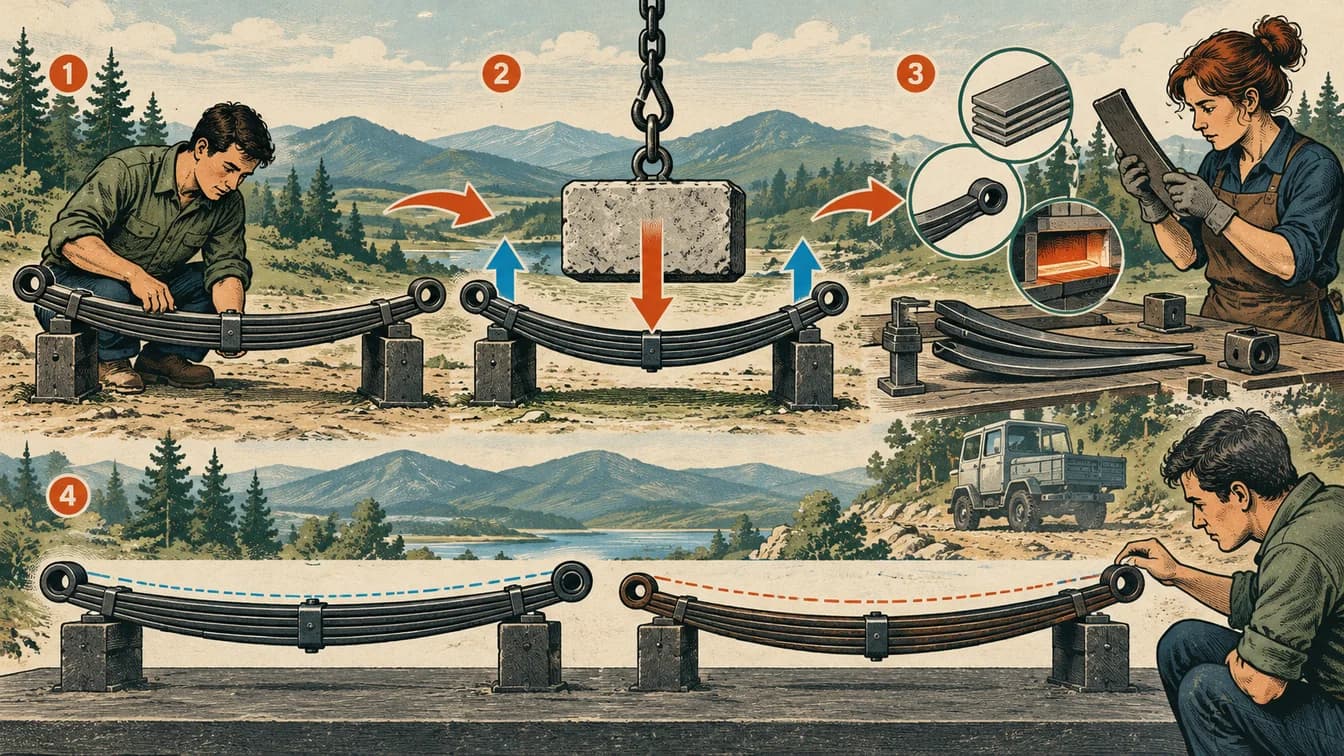
A load bends a spring away from its unloaded shape. The spring exerts a restoring force.
In an ideal elastic model, increasing deflection increases restoring force. A real component has a range over which that model is useful.
Material, geometry and manufacturing choices affect performance. Standen’s describes modelling and heat-treatment methods; the illustration is not its production specification.
Testing compares the component with its intended duty. A spring that remains deformed after unloading raises a different question from one that returns to its starting shape.
The numbers are invented teaching data, not Standen’s test results. A leaf-spring assembly is not necessarily linear at every load. Spring stiffness, damping and material strength are different properties.
The lesson, in the real world
A spring has to move under a load and still be ready for the next one.
- 1
A load bends a spring away from its unloaded shape. The spring exerts a restoring force.
Our explanation - 2
In an ideal elastic model, increasing deflection increases restoring force. A real component has a range over which that model is useful.
Our explanation - 3
Material, geometry and manufacturing choices affect performance. Standen’s describes modelling and heat-treatment methods; the illustration is not its production specification.
Our explanation - 4
Testing compares the component with its intended duty. A spring that remains deformed after unloading raises a different question from one that returns to its starting shape.
Our explanation
Who does this work
Role
Mechanical design and prototyping
Translate a need into a component or machine that can be built and tested. Designers use dimensions, material properties and constraints to evaluate alternatives.
What might you actually do?
Investigate
Create and revise drawings or a digital model.
Test and compare
Choose materials and dimensions for the intended conditions.
Explain and improve
Compare the prototype with its requirements and refine the design.
Typical of this kind of work in general. Not a description of any one person’s job at Standen’s (IMT).
- Often works with
- Machinists, fabricators, test staff and customers
- Classroom connection
- Geometry, forces and material properties shape real design trade-offs.
Related job postings
Similar work at other employers in Calgary, AB, not openings at Standen’s (IMT). These are live searches: results change daily and we have not checked them.
How to prepare
Mechanical Engineering Technology
SAIT
Ways in
For your students
Ways to prepare for this work
Programs that teach skills this work uses. Each is one route in, not a requirement, and no program has endorsed this page.
Showing routes for mechanical design and prototyping. Show all
SAITDiplomaCalgary
Mechanical Engineering Technology
Design, modelling and mechanical-system analysis.
About this route
A technical route; does not itself confer professional engineer registration. Check current admissions and intake before applying; this draft does not promise entry or employment.
Why it connects to the work · our interpretation
Mechanical design and prototypingDesign, modelling and mechanical-system analysis. A model is useful when its assumptions are clear and measurements can challenge it.
Ask the class
Use it in class
Ask the class
Would the stiffest possible spring always be the best suspension spring?
Use an invented table: load 0, 100, 200, 300 N; deflection 0, 2, 4, 6 mm. Plot load against deflection, calculate the model stiffness, and predict 400 N only within the assumed elastic range. A second sample retains 1 mm deflection after unloading: discuss why the same model may no longer describe it.
Mindset it shows
The numbers are invented teaching data, not Standen’s test results. A leaf-spring assembly is not necessarily linear at every load. Spring stiffness, damping and material strength are different properties.
About Standen’s (IMT)

A spring has to move under a load and still be ready for the next one.
- Headquarters
- Headquarters not separately verified for this example.
- Local connection
- Calgary manufacturing facility stated on current company homepage.
- Source: standens.com — official website(opens in a new tab); standens.com — leaf springs(opens in a new tab); standens.com — standens ordering and service announcement(opens in a new tab); standens.com — careers(opens in a new tab)
- Team size
- Not verified. We have not found a dated, sourced figure.
- The problem
- Why can a steel spring bend repeatedly without staying bent?
- Source: standens.com — official website(opens in a new tab); standens.com — leaf springs(opens in a new tab); standens.com — standens ordering and service announcement(opens in a new tab); standens.com — careers(opens in a new tab)
- What they do
- Leaf springs and suspension components
- Source: standens.com — official website(opens in a new tab); standens.com — leaf springs(opens in a new tab); standens.com — standens ordering and service announcement(opens in a new tab); standens.com — careers(opens in a new tab)
- Who uses it
- Vehicle and equipment makers, service businesses and people who depend on suspension components.
- Source: standens.com — official website(opens in a new tab); standens.com — leaf springs(opens in a new tab); standens.com — standens ordering and service announcement(opens in a new tab); standens.com — careers(opens in a new tab)
IMT Standen’s manufactures leaf springs and suspension components in Calgary. Its product information describes modelling, analysis and controlled heat treatment as part of its manufacturing work. The useful classroom problem is the balance between flexibility and a component that keeps its shape. This is a manufacturing story; a 2026 announcement places distribution through a UAP partnership.
Source: standens.com — official website(opens in a new tab); standens.com — leaf springs(opens in a new tab); standens.com — standens ordering and service announcement(opens in a new tab); standens.com — careers(opens in a new tab)Read each source’s date and scope: a documented role is not proof of a current vacancy or of where every position is based.
Reported as Standen’s (IMT) states it. Standen’s (IMT) has not reviewed or endorsed this page.
Sources and course fit
Sources checked 18 Oct 2026
Where it fits
- Physics 20 · D1 — oscillatory motion and restoring force
Editorial mapping to published CBE course topics. Pending educator review. No outcome-code alignment is claimed.
Sources
- standens.com — official website(opens in a new tab)
- standens.com — leaf springs(opens in a new tab)
- standens.com — standens ordering and service announcement(opens in a new tab)
- standens.com — careers(opens in a new tab)
- SAIT — Mechanical Engineering Technology(opens in a new tab)
- SAIT — Machinist(opens in a new tab)
- alberta.ca — edc physics20 30 performance standards.pdf(opens in a new tab)
Organization claims are reported as the organization states them. Standen’s (IMT) has not reviewed or endorsed this page.
What we know, and how
| Type | Claim | How we know |
|---|---|---|
| work | IMT Standen’s manufactures leaf springs and suspension components in Calgary. Its product information describes modelling, analysis and controlled heat treatment as part of its manufacturing work. The useful classroom problem is the balance between flexibility and a component that keeps its shape. This is a manufacturing story; a 2026 announcement places distribution through a UAP partnership.Source: standens.com — official website; standens.com — leaf springs; standens.com — standens ordering and service announcement; standens.com — careers | Company-stated work with source limits preserved |
| local connection | Calgary manufacturing facility stated on current company homepage.Source: standens.com — official website; standens.com — leaf springs; standens.com — standens ordering and service announcement; standens.com — careers | Source-backed Calgary connection |
| course fit | Alberta performance standards, printed pp. 17–18: restoring force, displacement and spring constant. Direct spring-model connection; fatigue, metallurgy and industrial leaf assemblies are extensions.Source: alberta.ca — edc physics20 30 performance standards.pdf | Editorial application of source-checked curriculum concepts |
| limits | The classroom data and generic spring assembly must remain labelled illustrative. Do not imply the example teaches actual heat-treatment settings or gives a specification for a roadworthy spring.Source: standens.com — official website; standens.com — leaf springs; standens.com — standens ordering and service announcement; standens.com — careers | Scope of this example |
Solid green: the organization states it. Outlined: seen in a dated source. Dashed: our interpretation, not yet researched, or announced but not yet real.