Classroom example NanoTess
Show your class · 1 of 5
The questionShow your class · 2 of 5
How it worksShow your class · 3 of 5
Who does this workShow your class · 4 of 5
Ways inShow your class · 5 of 5
Ask the classFor you
About NanoTessFor you
SourcesHow would you test whether a material changes a chemical process?
NanoTess · Federal grant record identifies Calgary laboratory/production scale-up; current company funding release describes ongoing materials development.
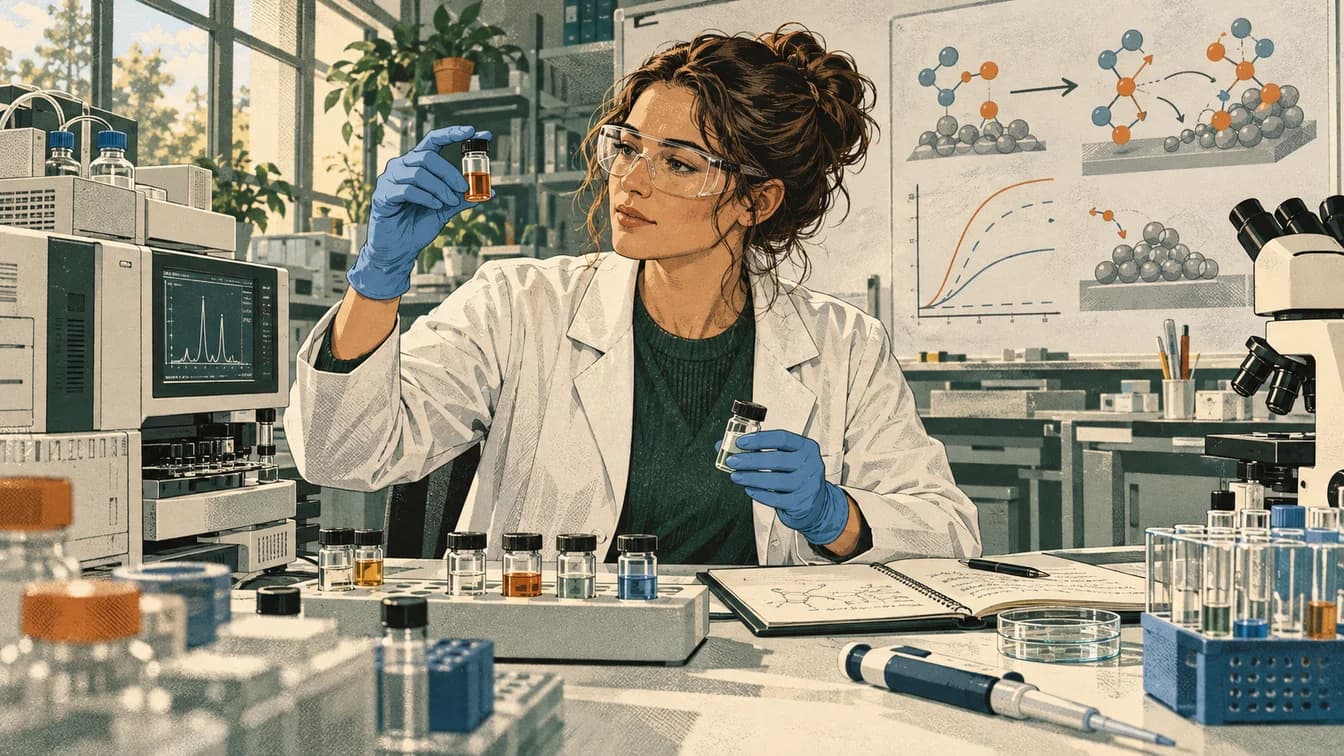
Where it fits
Pick your class- Chemistry 30 · Unit A — activation energy and catalysis
How it works
Schematic · not to scale
A material can change a process, but showing that requires a fair comparison.
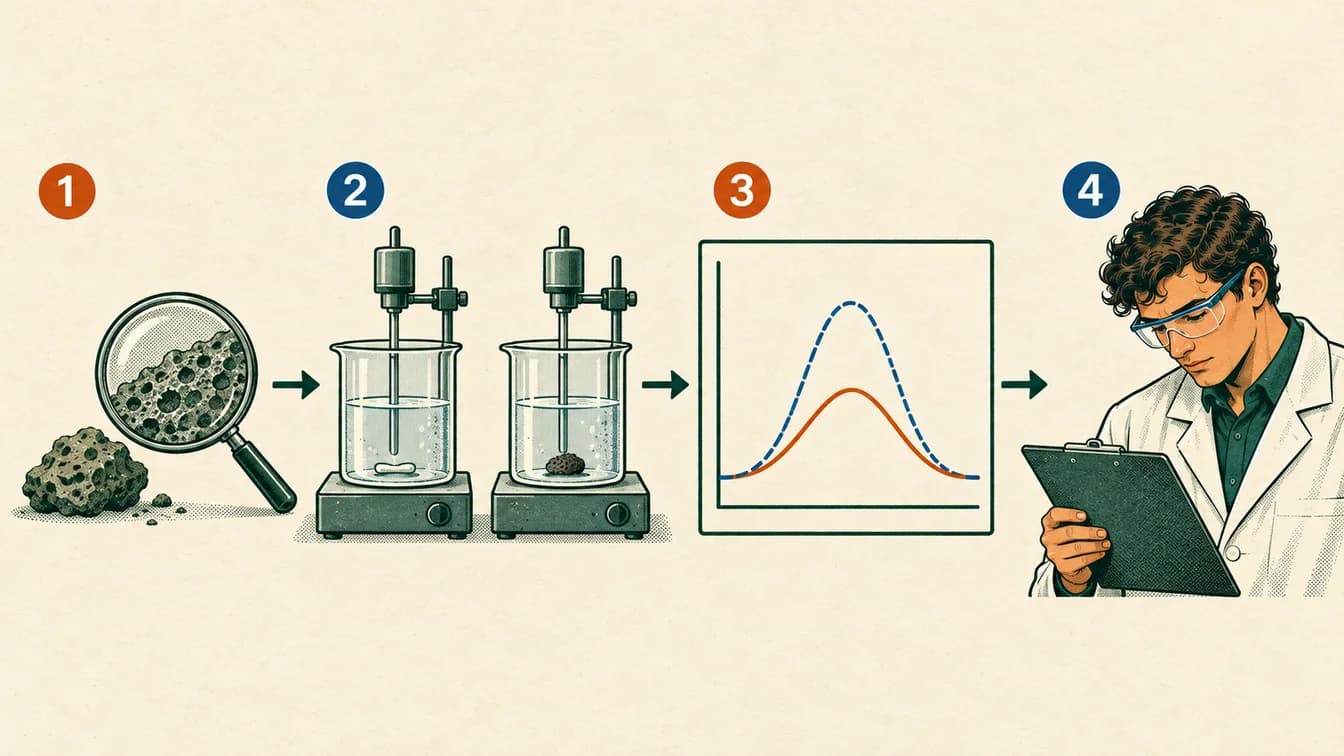
Start with a testable question: does adding a candidate material change the rate of a defined reaction?
Compare otherwise similar systems with and without that material, using a method that measures change over time.
A catalyst can provide an alternative reaction pathway. It does not supply unlimited energy or change the reaction's net energy difference.
A useful laboratory result answers the laboratory question. Claims about a product in people require additional, different evidence.
The diagrams model general catalysis, not NanoTess's proprietary mechanism. Do not infer clinical effectiveness, patient suitability or regulatory authorization from this activity. No product testing on skin or medical advice.
The lesson, in the real world
A material can change a process, but showing that requires a fair comparison.
- 1
Start with a testable question: does adding a candidate material change the rate of a defined reaction?
Our explanation - 2
Compare otherwise similar systems with and without that material, using a method that measures change over time.
Our explanation - 3
A catalyst can provide an alternative reaction pathway. It does not supply unlimited energy or change the reaction's net energy difference.
Our explanation - 4
A useful laboratory result answers the laboratory question. Claims about a product in people require additional, different evidence.
Our explanation
Who does this work
Role
Laboratory analysis
Make measurements that other people can trust. A laboratory worker prepares samples, uses a method consistently and records enough detail for someone else to interpret the result.
What might you actually do?
Investigate
Prepare and label samples so their identity is preserved.
Test and compare
Run comparisons or reference samples to check the method.
Explain and improve
Record results, units and limitations before sharing findings.
Typical of this kind of work in general. Not a description of any one person’s job at NanoTess.
- Often works with
- Scientists, process engineers and quality teams
- Classroom connection
- A repeatable method and a fair comparison matter as much as a single impressive number.
Related job postings
Similar work at other employers in Calgary, AB, not openings at NanoTess. These are live searches: results change daily and we have not checked them.
- Laboratory technicianIndeed search for Laboratory technician (opens in a new tab)Job Bank search for Laboratory technician (opens in a new tab)
- Laboratory technologistIndeed search for Laboratory technologist (opens in a new tab)Job Bank search for Laboratory technologist (opens in a new tab)
- Lab analystIndeed search for Lab analyst (opens in a new tab)Job Bank search for Lab analyst (opens in a new tab)
How to prepare
Chemical Laboratory Technology
SAIT
Chemistry or Biochemistry
University of Calgary
Ways in
For your students
Ways to prepare for this work
Programs that teach skills this work uses. Each is one route in, not a requirement, and no program has endorsed this page.
Showing routes for laboratory analysis. Show all
SAITDiplomaCalgary
Chemical Laboratory Technology
Chemical analysis, samples and laboratory practice.
About this route
A laboratory route; not a medical licence or automatic research-scientist qualification. Check current admissions and intake before applying; this draft does not promise entry or employment.
Why it connects to the work · our interpretation
Laboratory analysisChemical analysis, samples and laboratory practice. Fair comparisons are more informative than an isolated result.
University of CalgaryBSc program directionsCalgary
Chemistry or Biochemistry
Chemical or biochemical foundations and scientific investigation.
About this route
Choose the actual program and check its current requirements; advanced research may require further study. Check current admissions and intake before applying; this draft does not promise entry or employment.
Why it connects to the work · our interpretation
Laboratory analysisChemical or biochemical foundations and scientific investigation. Fair comparisons are more informative than an isolated result.
Ask the class
Use it in class
Ask the class
What could a faster laboratory reaction tell you—and what would it not tell you about wound care?
Draw two hypothetical energy diagrams with the same reactant and product levels but different activation barriers. Then design a paper-only controlled comparison: manipulated variable, responding variable, controls and repeats. Identify one extra evidence question that a health-product claim would raise.
Mindset it shows
The diagrams model general catalysis, not NanoTess's proprietary mechanism. Do not infer clinical effectiveness, patient suitability or regulatory authorization from this activity. No product testing on skin or medical advice.
About NanoTess

A material can change a process, but showing that requires a fair comparison.
- Headquarters
- Headquarters not separately verified for this example.
- Local connection
- Federal grant record identifies Calgary laboratory/production scale-up; current company funding release describes ongoing materials development.
- Source: search.open.canada.ca — nrc cnrc,172 2022 2023 Q4 1000203,current(opens in a new tab); nanotess.com — nanotess secures government of canada funding(opens in a new tab); nanotess.com — stampede rodeo uses nanosalv(opens in a new tab); nanotess.com — careers(opens in a new tab)
- Team size
- Not verified. We have not found a dated, sourced figure.
- The problem
- How would you test whether a material changes a chemical process?
- Source: search.open.canada.ca — nrc cnrc,172 2022 2023 Q4 1000203,current(opens in a new tab); nanotess.com — nanotess secures government of canada funding(opens in a new tab); nanotess.com — stampede rodeo uses nanosalv(opens in a new tab); nanotess.com — careers(opens in a new tab)
- What they do
- Develop catalytic materials for wound-care products.
- Source: search.open.canada.ca — nrc cnrc,172 2022 2023 Q4 1000203,current(opens in a new tab); nanotess.com — nanotess secures government of canada funding(opens in a new tab); nanotess.com — stampede rodeo uses nanosalv(opens in a new tab); nanotess.com — careers(opens in a new tab)
- Who uses it
- Healthcare product developers and clinical teams evaluating materials for care.
- Source: search.open.canada.ca — nrc cnrc,172 2022 2023 Q4 1000203,current(opens in a new tab); nanotess.com — nanotess secures government of canada funding(opens in a new tab); nanotess.com — stampede rodeo uses nanosalv(opens in a new tab); nanotess.com — careers(opens in a new tab)
NanoTess develops catalytic materials for wound-care products. A 2026 company account states that its NanoSALV Catalytic product and underlying technology were developed and made in Calgary; a federal grant record also describes laboratory and production scale-up. This story asks how researchers test a material's chemical action. It does not claim that a classroom catalyst experiment proves a medical benefit.
Source: search.open.canada.ca — nrc cnrc,172 2022 2023 Q4 1000203,current(opens in a new tab); nanotess.com — nanotess secures government of canada funding(opens in a new tab); nanotess.com — stampede rodeo uses nanosalv(opens in a new tab); nanotess.com — careers(opens in a new tab)Read each source’s date and scope: a documented role is not proof of a current vacancy or of where every position is based.
Reported as NanoTess states it. NanoTess has not reviewed or endorsed this page.
Sources and course fit
Sources checked 18 Oct 2026
Where it fits
- Chemistry 30 · Unit A — activation energy and catalysis
Editorial mapping to published CBE course topics. Pending educator review. No outcome-code alignment is claimed.
Sources
- search.open.canada.ca — nrc cnrc,172 2022 2023 Q4 1000203,current(opens in a new tab)
- nanotess.com — nanotess secures government of canada funding(opens in a new tab)
- nanotess.com — stampede rodeo uses nanosalv(opens in a new tab)
- nanotess.com — careers(opens in a new tab)
- SAIT — Chemical Laboratory Technology(opens in a new tab)
- University of Calgary — Chemistry or Biochemistry(opens in a new tab)
- education.alberta.ca — chem2030_07.pdf(opens in a new tab)
Organization claims are reported as the organization states them. NanoTess has not reviewed or endorsed this page.
What we know, and how
| Type | Claim | How we know |
|---|---|---|
| work | NanoTess develops catalytic materials for wound-care products. A 2026 company account states that its NanoSALV Catalytic product and underlying technology were developed and made in Calgary; a federal grant record also describes laboratory and production scale-up. This story asks how researchers test a material's chemical action. It does not claim that a classroom catalyst experiment proves a medical benefit.Source: search.open.canada.ca — nrc cnrc,172 2022 2023 Q4 1000203,current; nanotess.com — nanotess secures government of canada funding; nanotess.com — stampede rodeo uses nanosalv; nanotess.com — careers | Company-stated work with source limits preserved |
| local connection | Federal grant record identifies Calgary laboratory/production scale-up; current company funding release describes ongoing materials development.Source: search.open.canada.ca — nrc cnrc,172 2022 2023 Q4 1000203,current; nanotess.com — nanotess secures government of canada funding; nanotess.com — stampede rodeo uses nanosalv; nanotess.com — careers | Source-backed Calgary connection |
| course fit | 30–A2.1k–A2.4k cover activation energy, energy diagrams and catalytic pathways. Direct concept fit; the wound-care application is context, not an outcome or validated mechanism demonstration.Source: education.alberta.ca — chem2030_07.pdf | Editorial application of source-checked curriculum concepts |
| limits | Retain attribution for the Calgary product claim. Clinical performance and medical-device status were not independently established; the proposed copy omits efficacy claims and regulatory assertions.Source: search.open.canada.ca — nrc cnrc,172 2022 2023 Q4 1000203,current; nanotess.com — nanotess secures government of canada funding; nanotess.com — stampede rodeo uses nanosalv; nanotess.com — careers | Scope of this example |
Solid green: the organization states it. Outlined: seen in a dated source. Dashed: our interpretation, not yet researched, or announced but not yet real.