Classroom example Livestock Water Recycling
Show your class · 1 of 5
The questionShow your class · 2 of 5
How it worksShow your class · 3 of 5
Who does this workShow your class · 4 of 5
Ways inShow your class · 5 of 5
Ask the classFor you
About Livestock Water RecyclingFor you
SourcesCan we recover useful water and nutrients from manure?
Livestock Water Recycling · Innovation centre and manufacturing plant in Calgary; farm installations are not assumed to be in the city.
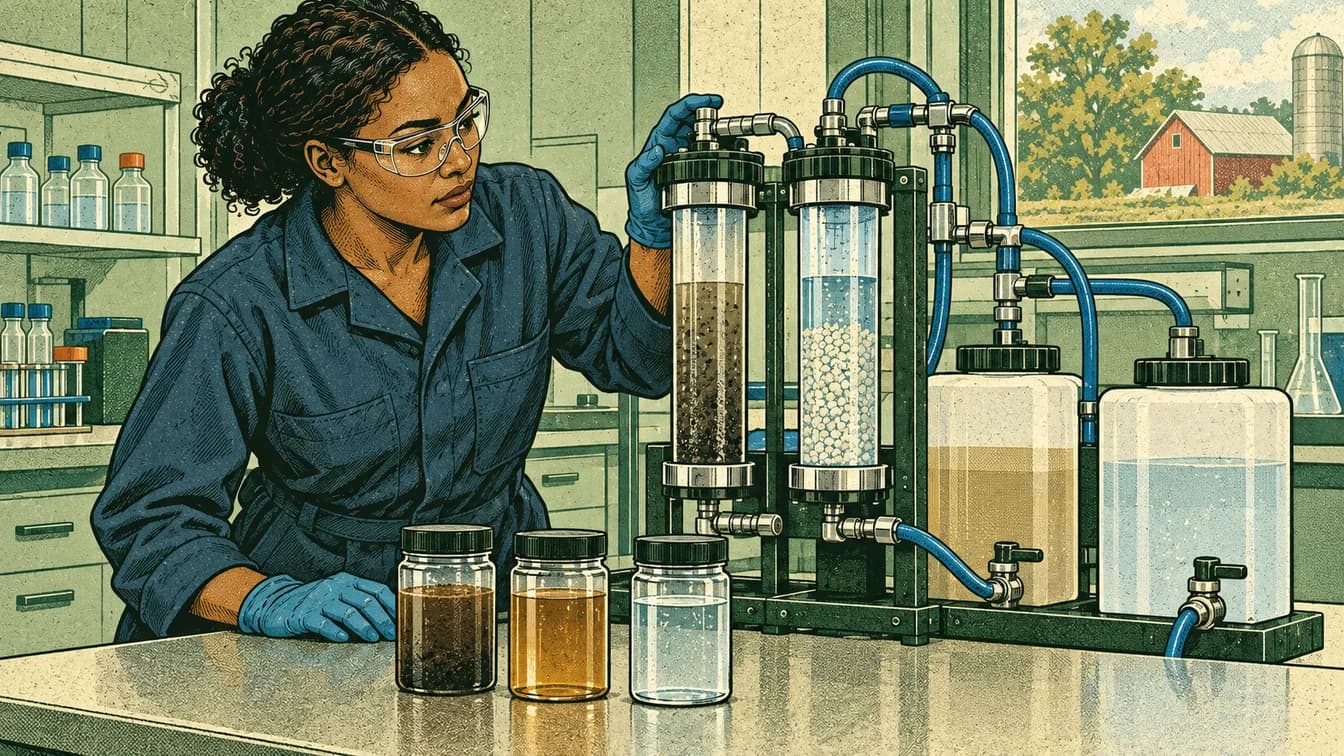
Where it fits
Pick your class- Chemistry 20 · Mixtures and solution concentration
- Science 30 · Chemistry and the environment
How it works
Schematic · not to scale
Follow the material into different streams
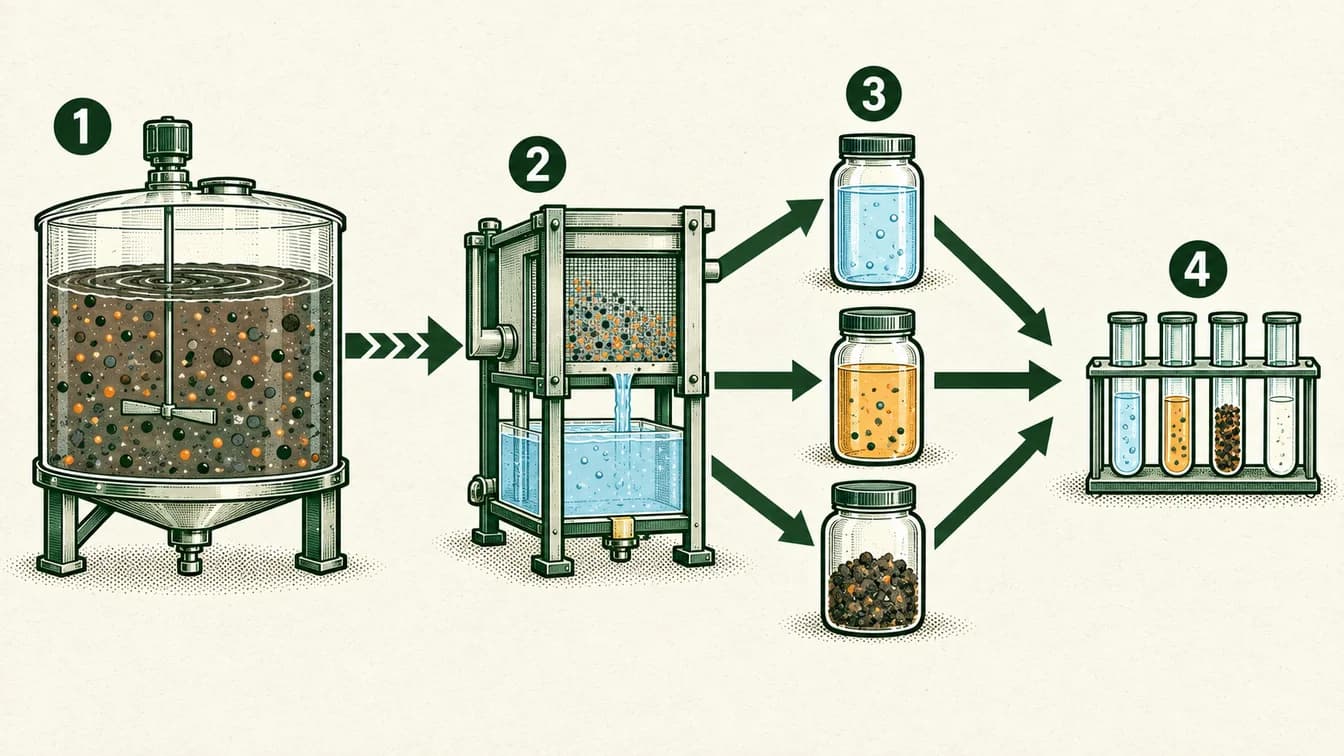
Start with manure containing water and other material.
Apply physical and chemical separation steps.
Collect different water, nutrient and solid streams.
Test the outputs against their intended uses.
Clear appearance does not prove drinking-water quality. Actual performance requires measurements.
The lesson, in the real world
Waste contains materials that can be separated and used again.
- 1
Manure is a mixture containing water, solids and nutrients. Treating it as a single stream limits how its components can be managed.
Our explanation - 2
LWR describes sequential solids removal and mechanical and chemical treatment in its PLANT system.
Our explanation - 3
Separated material can follow different paths: solids, concentrated nutrients and recovered water. Their suitability depends on measurement and intended use.
Our explanation - 4
Evaluate the whole system: what happens to every output, how much energy is needed and whether the result meets the requirements for its next use.
Our explanation
Who does this work
Role
Process engineering
Turn a useful transformation into a workable sequence of equipment and operating steps. Process engineers consider what enters, what leaves and what conditions the system must maintain.
What might you actually do?
Investigate
Draw a flow of materials and energy through the system.
Test and compare
Compare operating conditions and equipment options.
Explain and improve
Use trial results to revise the process and communicate constraints.
Typical of this kind of work in general. Not a description of any one person’s job at Livestock Water Recycling.
- Often works with
- Laboratory staff, operators, mechanical designers and controls specialists
- Classroom connection
- Conservation of matter and energy connects classroom calculations to process decisions.
Related job postings
Similar work at other employers in Calgary, AB, not openings at Livestock Water Recycling. These are live searches: results change daily and we have not checked them.
How to prepare
Chemical Engineering
University of Calgary
Ways in
For your students
Ways to prepare for this work
Programs that teach skills this work uses. Each is one route in, not a requirement, and no program has endorsed this page.
Showing routes for process engineering. Show all
University of CalgaryBachelor’s degreeCalgary
Chemical Engineering
Study how to transform raw materials and design production processes.
About this route
Check the provider’s current prerequisites and intake availability. This is a related learning route, not a hiring promise or an employer requirement.
Why it connects to the work · our interpretation
Process engineeringSupports process design and scale-up; experience and professional requirements remain separate. Conservation of matter and energy connects classroom calculations to process decisions.
Ask the class
Use it in class
Ask the class
Why is clear-looking water not enough evidence that it is suitable for every use?
Draw a mass-flow diagram with one incoming stream and three outgoing streams. Ask students to identify measurements needed to account for both water and nutrients.
Mindset it shows
No manure handling is required. The exercise uses a conceptual diagram; concentration and total amount are different quantities.
About Livestock Water Recycling

Waste contains materials that can be separated and used again.
- Headquarters
- Innovation centre and manufacturing plant in Calgary; farm installations are not assumed to be in the city.
- Source: PLANT process(opens in a new tab); Calgary research work(opens in a new tab); Local facility(opens in a new tab); Employer role evidence(opens in a new tab)
- Local connection
- Innovation centre and manufacturing plant in Calgary; farm installations are not assumed to be in the city.
- Source: PLANT process(opens in a new tab); Calgary research work(opens in a new tab); Local facility(opens in a new tab); Employer role evidence(opens in a new tab)
- Team size
- Not verified. We have not found a dated, sourced figure.
- The problem
- How can the components of manure be managed separately rather than as one large mixed stream?
- Source: PLANT process(opens in a new tab); Calgary research work(opens in a new tab); Local facility(opens in a new tab); Employer role evidence(opens in a new tab)
- What they do
- Treatment systems that separate nutrient streams and recover water for reuse.
- Source: PLANT process(opens in a new tab); Calgary research work(opens in a new tab); Local facility(opens in a new tab); Employer role evidence(opens in a new tab)
- Who uses it
- Farm operators and other users managing manure or similar nutrient-rich liquids.
- Source: PLANT process(opens in a new tab); Calgary research work(opens in a new tab); Local facility(opens in a new tab); Employer role evidence(opens in a new tab)
Livestock Water Recycling develops manure-treatment systems from a Calgary innovation centre and manufacturing plant. Its PLANT process uses mechanical and chemical treatments to separate solids, nutrient-rich material and water. The company describes uses at livestock operations and other facilities handling nutrient-laden liquids.
Source: PLANT process(opens in a new tab); Calgary research work(opens in a new tab); Local facility(opens in a new tab); Employer role evidence(opens in a new tab)Read each source’s date and scope: a documented role is not proof of a current vacancy or of where every position is based.
Reported as Livestock Water Recycling states it. Livestock Water Recycling has not reviewed or endorsed this page.
Sources and course fit
Sources checked 15 Oct 2026
Where it fits
- Chemistry 20 · Mixtures and solution concentration
- Science 30 · Chemistry and the environment
Editorial mapping to published CBE course topics. Pending educator review. No outcome-code alignment is claimed.
Sources
- Alberta Chemistry 20–30 program of studies (updated 2014)(opens in a new tab)
- SAIT — Chemical Laboratory Technology(opens in a new tab)
- University of Calgary — Chemical Engineering(opens in a new tab)
- SAIT — Instrumentation Engineering Technology(opens in a new tab)
- PLANT process(opens in a new tab)
- Calgary research work(opens in a new tab)
- Local facility(opens in a new tab)
- Employer role evidence(opens in a new tab)
- Calgary Board of Education: Science 10/20/30 course topics(opens in a new tab)
Organization claims are reported as the organization states them. Livestock Water Recycling has not reviewed or endorsed this page.
What we know, and how
| Type | Claim | How we know |
|---|---|---|
| work | Livestock Water Recycling develops manure-treatment systems from a Calgary innovation centre and manufacturing plant. Its PLANT process uses mechanical and chemical treatments to separate solids, nutrient-rich material and water. The company describes uses at livestock operations and other facilities handling nutrient-laden liquids.Source: PLANT process; Calgary research work; Local facility; Employer role evidence | Organization-stated |
| local connection | Innovation centre and manufacturing plant in Calgary; farm installations are not assumed to be in the city.Source: PLANT process; Calgary research work; Local facility; Employer role evidence | Organization-stated |
| course fit | Compare what remains in different output streams. Clearer water is not automatically safe drinking water.Source: Alberta Chemistry 20–30 program of studies (updated 2014); Calgary Board of Education: Science 10/20/30 course topics | Editorial connection to verified course topics |
| limits | Do not reproduce claims that all pathogens or all runoff risk are eliminated. Water reuse is not a blanket drinking-water-safety claim. The commissioning role supports clients across the USA; do not label all of that work Calgary-based.Source: PLANT process; Calgary research work; Local facility; Employer role evidence | Scope of this example |
Solid green: the organization states it. Outlined: seen in a dated source. Dashed: our interpretation, not yet researched, or announced but not yet real.