Classroom example Joe Media Group
Show your class · 1 of 5
The questionShow your class · 2 of 5
How it worksShow your class · 3 of 5
Who does this workShow your class · 4 of 5
Ways inShow your class · 5 of 5
Ask the classFor you
About Joe Media GroupFor you
SourcesHow can light and editing make separate shots feel like one scene?
Joe Media Group · The company identifies a Calgary production operation and Calgary contact location.

Where it fits
Pick your class- Physics 30 · Reflection, refraction and camera image formation
How it works
Schematic · not to scale
Separate light capture from editing
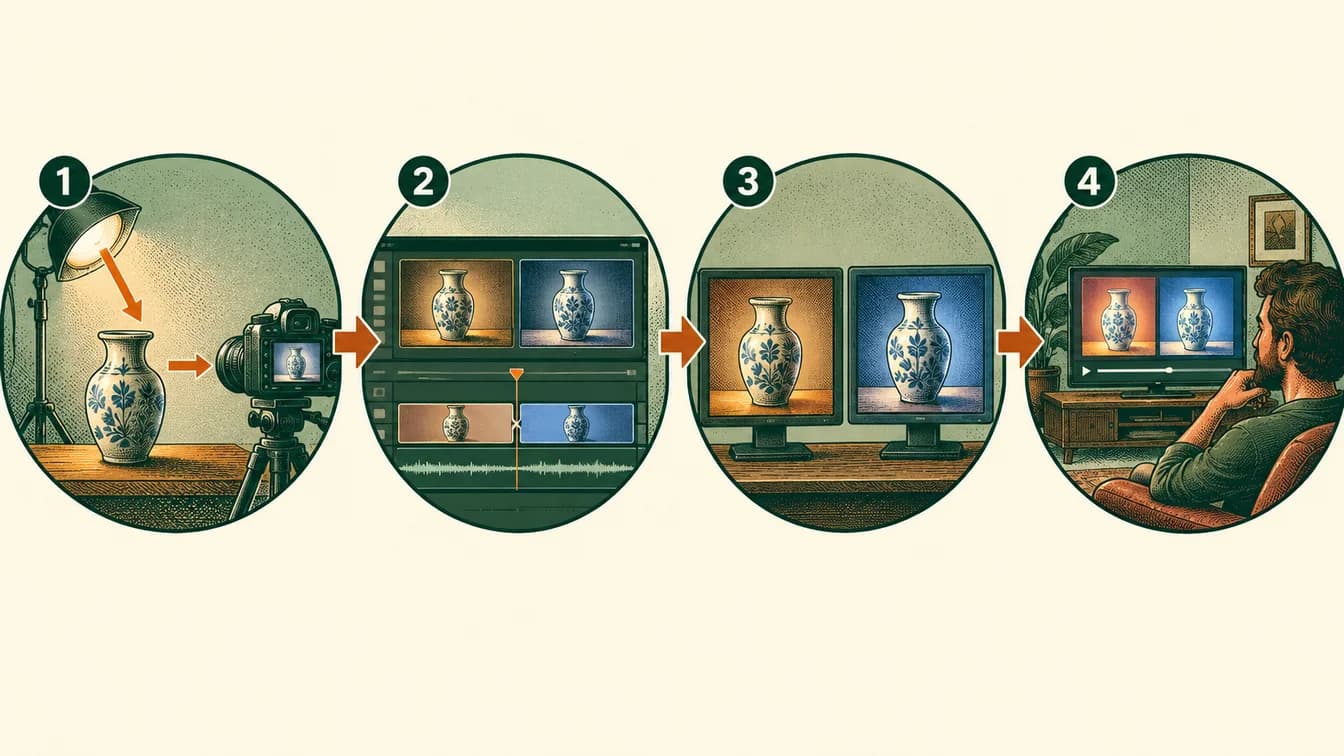
Light reaches the subject, reflects toward the camera and passes through its lens.
Select and arrange recorded shots.
Compare and adjust their appearance.
Review the sequence for continuity and meaning.
A camera receives light; it does not send a scanning beam. Lens refraction forms the image at the sensor. Later colour edits change recorded values, not the original scene.
The lesson, in the real world
A scene can be assembled from images recorded at different moments.
- 1
Light reflects from a subject and is refracted by a camera lens to form an image at the sensor.
Our explanation - 2
Changing the lighting or camera settings can change the appearance of the same subject.
Our explanation - 3
An editor arranges selected shots into a sequence; a colourist can work on differences in their appearance.
Our explanation - 4
Review the sequence for continuity and meaning. A smooth-looking cut is a creative result, not proof that the events happened continuously.
Our explanation
Who does this work
Role
Film and video editing
Build a sequence from selected footage to communicate a coherent idea.
What might you actually do?
Investigate
Review and organize available footage.
Test and compare
Choose cuts, order and timing for the intended story.
Document and improve
Check continuity and revise against feedback.
Typical of this kind of work in general. Not a description of any one person’s job at Joe Media Group.
- Often works with
- Directors, producers, colourists and sound teams
- Classroom connection
- Sequence can change interpretation even when the individual images stay the same.
Related job postings
Similar work at other employers in Calgary, AB, not openings at Joe Media Group. These are live searches: results change daily and we have not checked them.
How to prepare
Film and Video Production
SAIT
Ways in
For your students
Ways to prepare for this work
Programs that teach skills this work uses. Each is one route in, not a requirement, and no program has endorsed this page.
Showing routes for film and video editing. Show all
SAITDiplomaCalgary
Film and Video Production
Practise production and post-production through film projects.
About this route
Check current admission, portfolio, intake and workplace requirements; program completion does not guarantee a job or professional registration.
Why it connects to the work · our interpretation
Film and video editingSupports camera, editing and production work; a portfolio remains important. Sequence can change interpretation even when the individual images stay the same.
Ask the class
Use it in class
Ask the class
How can the order of two shots change what a viewer thinks happened?
Sketch the path of light from a lamp to an object, then through a converging camera lens to the sensor. Compare two fictional shots with different lighting. Which differences come from the light reaching the camera, and which could be introduced during colour editing?
Mindset it shows
Use a thin-lens ray model for image formation. It simplifies a multi-element camera lens. Colour editing changes recorded pixel values; it does not change the light that originally reached the camera. This is an editorial classroom task, not a named client shoot.
About Joe Media Group

A scene can be assembled from images recorded at different moments.
- Headquarters
- Headquarters not separately verified for this example.
- Local connection
- The company identifies a Calgary production operation and Calgary contact location.
- Source: Joe Media Group — company/project evidence 1(opens in a new tab); Joe Media Group — company/project evidence 2(opens in a new tab); Joe Media Group — company/project evidence 3(opens in a new tab); Joe Media Group — company/project evidence 4(opens in a new tab)
- Team size
- Not verified. We have not found a dated, sourced figure.
- The problem
- How can light and editing make separate shots feel like one scene?
- Source: Joe Media Group — company/project evidence 1(opens in a new tab); Joe Media Group — company/project evidence 2(opens in a new tab); Joe Media Group — company/project evidence 3(opens in a new tab); Joe Media Group — company/project evidence 4(opens in a new tab)
- What they do
- Film and television production, editing and colour finishing.
- Source: Joe Media Group — company/project evidence 1(opens in a new tab); Joe Media Group — company/project evidence 2(opens in a new tab); Joe Media Group — company/project evidence 3(opens in a new tab); Joe Media Group — company/project evidence 4(opens in a new tab)
- Who uses it
- Production clients, creative teams and audiences.
- Source: Joe Media Group — company/project evidence 1(opens in a new tab); Joe Media Group — company/project evidence 2(opens in a new tab); Joe Media Group — company/project evidence 3(opens in a new tab); Joe Media Group — company/project evidence 4(opens in a new tab)
Joe Media Group is a Calgary film and television production company. It describes work in production, editing and colour, and its post-production portfolio includes several formats. The classroom story examines how images are captured and matched. It does not claim that a particular technique or teaching exercise was used on a named production.
Source: Joe Media Group — company/project evidence 1(opens in a new tab); Joe Media Group — company/project evidence 2(opens in a new tab); Joe Media Group — company/project evidence 3(opens in a new tab); Joe Media Group — company/project evidence 4(opens in a new tab)Read each source’s date and scope: a documented role is not proof of a current vacancy or of where every position is based.
Reported as Joe Media Group states it. Joe Media Group has not reviewed or endorsed this page.
Sources and course fit
Sources checked 17 Oct 2026
Where it fits
- Physics 30 · Reflection, refraction and camera image formation
Editorial mapping to published CBE course topics. Pending educator review. No outcome-code alignment is claimed.
Sources
- Alberta Physics 20–30 performance standards: A1, B1 and C1(opens in a new tab)
- AUArts — Bachelor of Design(opens in a new tab)
- SAIT — Film and Video Production(opens in a new tab)
- Joe Media Group — company/project evidence 1(opens in a new tab)
- Joe Media Group — company/project evidence 2(opens in a new tab)
- Joe Media Group — company/project evidence 3(opens in a new tab)
- Joe Media Group — company/project evidence 4(opens in a new tab)
Organization claims are reported as the organization states them. Joe Media Group has not reviewed or endorsed this page.
What we know, and how
| Type | Claim | How we know |
|---|---|---|
| work | Joe Media Group is a Calgary film and television production company. It describes work in production, editing and colour, and its post-production portfolio includes several formats. The classroom story examines how images are captured and matched. It does not claim that a particular technique or teaching exercise was used on a named production.Source: Joe Media Group — company/project evidence 1; Joe Media Group — company/project evidence 2; Joe Media Group — company/project evidence 3; Joe Media Group — company/project evidence 4 | Source-backed company/project account |
| local connection | The company identifies a Calgary production operation and Calgary contact location.Source: Joe Media Group — company/project evidence 1; Joe Media Group — company/project evidence 2; Joe Media Group — company/project evidence 3; Joe Media Group — company/project evidence 4 | Source-backed local work |
| course fit | Physics 30 C1 includes reflection, refraction and thin-lens image formation. Follow light from subject through lens to sensor, then distinguish physical capture from editorial colour changes.Source: Alberta Physics 20–30 performance standards: A1, B1 and C1 | Editorial application of verified curriculum topics |
| limits | The optics activity supplies the Physics 30 connection. Film continuity and colour finishing are creative applications, not separate mandated physics outcomes.Source: Joe Media Group — company/project evidence 1; Joe Media Group — company/project evidence 2; Joe Media Group — company/project evidence 3; Joe Media Group — company/project evidence 4 | Scope of this example |
Solid green: the organization states it. Outlined: seen in a dated source. Dashed: our interpretation, not yet researched, or announced but not yet real.