Classroom example ISL Engineering
Show your class · 1 of 5
The questionShow your class · 2 of 5
How it worksShow your class · 3 of 5
Who does this workShow your class · 4 of 5
Ways inShow your class · 5 of 5
Ask the classFor you
About ISL EngineeringFor you
SourcesHow can a road cross a creek without ignoring the landscape?
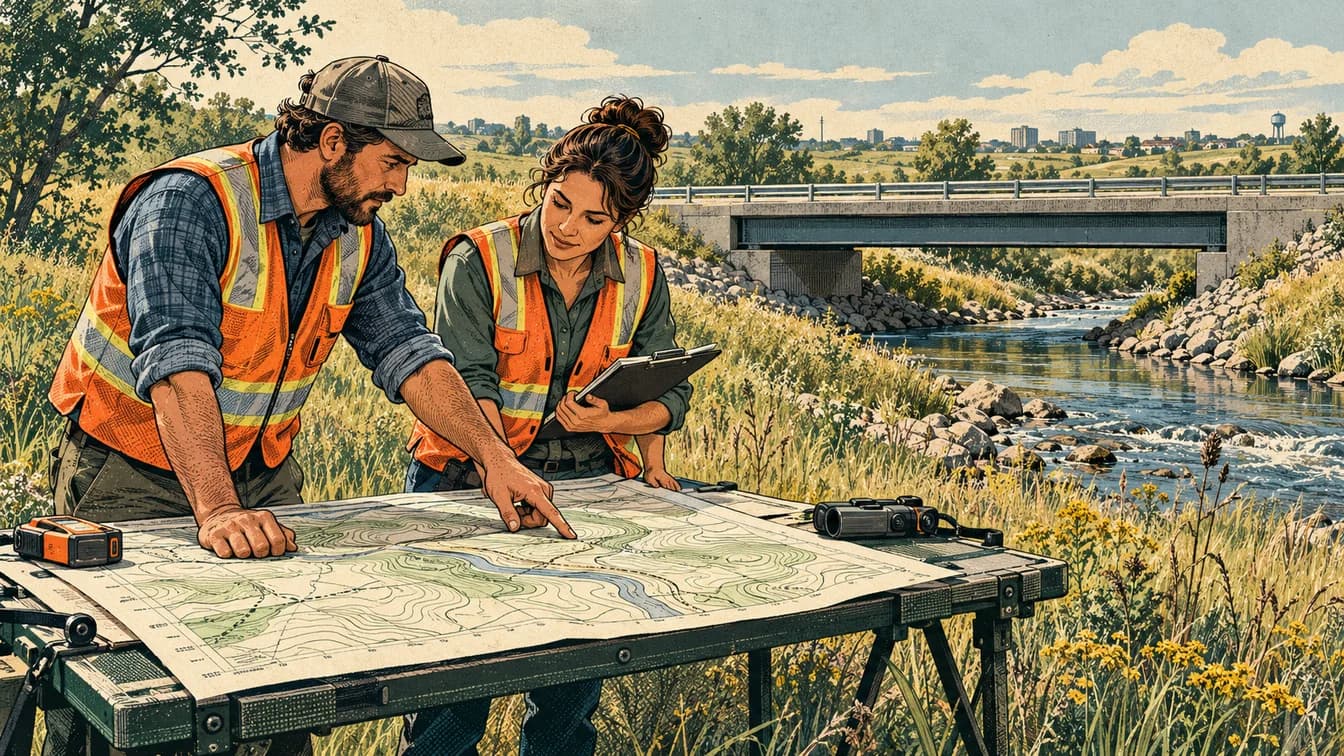
ISL Engineering · The featured road, creek crossing and pathways are in Calgary; ISL identifies the City as client.
Where it fits
Pick your class- Biology 20 · Aquatic ecosystems and environmental evidence
How it works
Schematic · not to scale
Design a crossing with its landscape in view

Observe terrain, water and habitat.
Compare routes and their constraints.
Coordinate the road, pathway and creek crossing.
Check conditions and monitor the affected landscape.
A generic crossing, not the actual 144 Avenue design. Monitoring is needed to establish environmental outcomes; a design intention is not a measured result.
The lesson, in the real world
A route has to work for people and for the ground and water beneath it.
- 1
Map the terrain, existing connections and watercourse before drawing a route.
Our explanation - 2
Compare options for gradients, crossings and access. A change in one constraint can affect another.
Our explanation - 3
Bring transportation, structural, water and environmental expertise together to develop the design.
Our explanation - 4
Check the built corridor against its intended function and monitor the landscape it affects. Design intent is not a measured ecological outcome.
Our explanation
Who does this work
Role
Civil and construction technology
Turn project requirements into usable drawings, quantities and checks.
What might you actually do?
Investigate
Prepare technical drawings using measured site information.
Test and compare
Check dimensions and interfaces between design disciplines.
Document and improve
Support construction records and field verification.
Typical of this kind of work in general. Not a description of any one person’s job at ISL Engineering.
- Often works with
- Engineers, surveyors and site teams
- Classroom connection
- Scale and accurate measurements connect a drawing to the real location.
Related job postings
Similar work at other employers in Calgary, AB, not openings at ISL Engineering. These are live searches: results change daily and we have not checked them.
- Civil engineering technologistIndeed search for Civil engineering technologist (opens in a new tab)Job Bank search for Civil engineering technologist (opens in a new tab)
- Drafting technicianIndeed search for Drafting technician (opens in a new tab)Job Bank search for Drafting technician (opens in a new tab)
- CAD technicianIndeed search for CAD technician (opens in a new tab)Job Bank search for CAD technician (opens in a new tab)
How to prepare
Civil Engineering Technology, Municipal Major
SAIT
Civil Engineering
University of Calgary
Ways in
For your students
Ways to prepare for this work
Programs that teach skills this work uses. Each is one route in, not a requirement, and no program has endorsed this page.
Showing routes for civil and construction technology. Show all
SAITDiplomaCalgary
Civil Engineering Technology, Municipal Major
Study municipal infrastructure, design and drafting.
About this route
Check current admission, portfolio, intake and workplace requirements; program completion does not guarantee a job or professional registration.
Why it connects to the work · our interpretation
Civil and construction technologyTechnical design and project delivery; not professional engineer licensure. Scale and accurate measurements connect a drawing to the real location.
University of CalgaryBachelor’s degreeCalgary
Civil Engineering
Study the design and operation of structures, transportation and water infrastructure.
About this route
Check current admissions and program requirements. A degree is not automatic professional licensure.
Why it connects to the work · our interpretation
Civil and construction technologyA degree foundation for engineering work; professional registration and supervised experience are separate. Scale and accurate measurements connect a drawing to the real location.
Ask the class
Use it in class
Ask the class
Why might the shortest route be a poor design?
Choose between two fictional corridors: one is shorter but steep and crosses a creek twice; one is longer and crosses once. List evidence needed before selecting either, without inventing a numerical score.
Mindset it shows
The exercise is not the actual route evaluation. No claim that the real creek project had a measured biodiversity improvement is made.
About ISL Engineering

A route has to work for people and for the ground and water beneath it.
- Headquarters
- Headquarters not separately verified for this example.
- Local connection
- The featured road, creek crossing and pathways are in Calgary; ISL identifies the City as client.
- Source: ISL Engineering — company/project evidence 1(opens in a new tab); ISL Engineering — company/project evidence 2(opens in a new tab); ISL Engineering — company/project evidence 3(opens in a new tab); ISL Engineering — company/project evidence 4(opens in a new tab)
- Team size
- Not verified. We have not found a dated, sourced figure.
- The problem
- How can a road cross a creek without ignoring the landscape?
- Source: ISL Engineering — company/project evidence 1(opens in a new tab); ISL Engineering — company/project evidence 2(opens in a new tab); ISL Engineering — company/project evidence 3(opens in a new tab); ISL Engineering — company/project evidence 4(opens in a new tab)
- What they do
- Infrastructure planning, engineering and construction support, including Calgary’s 144 Avenue NW extension.
- Source: ISL Engineering — company/project evidence 1(opens in a new tab); ISL Engineering — company/project evidence 2(opens in a new tab); ISL Engineering — company/project evidence 3(opens in a new tab); ISL Engineering — company/project evidence 4(opens in a new tab)
- Who uses it
- Municipal project teams and people travelling through the completed corridor.
- Source: ISL Engineering — company/project evidence 1(opens in a new tab); ISL Engineering — company/project evidence 2(opens in a new tab); ISL Engineering — company/project evidence 3(opens in a new tab); ISL Engineering — company/project evidence 4(opens in a new tab)
ISL was the City of Calgary’s prime consultant for planning, detailed design and construction work on the 144 Avenue NW extension. Its project account describes steep terrain, a single-span bridge over West Nose Creek, creek work and multi-use pathways. This creates a local example of design constraints interacting, rather than a story about choosing the shortest line on a map.
Source: ISL Engineering — company/project evidence 1(opens in a new tab); ISL Engineering — company/project evidence 2(opens in a new tab); ISL Engineering — company/project evidence 3(opens in a new tab); ISL Engineering — company/project evidence 4(opens in a new tab)Read each source’s date and scope: a documented role is not proof of a current vacancy or of where every position is based.
Reported as ISL Engineering states it. ISL Engineering has not reviewed or endorsed this page.
Sources and course fit
Sources checked 17 Oct 2026
Where it fits
- Biology 20 · Aquatic ecosystems and environmental evidence
Editorial mapping to published CBE course topics. Pending educator review. No outcome-code alignment is claimed.
Sources
- Alberta Biology 20–30 program: water use and ecosystems(opens in a new tab)
- SAIT — Geomatics Engineering Technology(opens in a new tab)
- SAIT — Environmental Technology(opens in a new tab)
- University of Calgary — Civil Engineering(opens in a new tab)
- SAIT — Civil Engineering Technology, Municipal Major(opens in a new tab)
- ISL Engineering — company/project evidence 1(opens in a new tab)
- ISL Engineering — company/project evidence 2(opens in a new tab)
- ISL Engineering — company/project evidence 3(opens in a new tab)
- ISL Engineering — company/project evidence 4(opens in a new tab)
Organization claims are reported as the organization states them. ISL Engineering has not reviewed or endorsed this page.
What we know, and how
| Type | Claim | How we know |
|---|---|---|
| work | ISL was the City of Calgary’s prime consultant for planning, detailed design and construction work on the 144 Avenue NW extension. Its project account describes steep terrain, a single-span bridge over West Nose Creek, creek work and multi-use pathways. This creates a local example of design constraints interacting, rather than a story about choosing the shortest line on a map.Source: ISL Engineering — company/project evidence 1; ISL Engineering — company/project evidence 2; ISL Engineering — company/project evidence 3; ISL Engineering — company/project evidence 4 | Source-backed company/project account |
| local connection | The featured road, creek crossing and pathways are in Calgary; ISL identifies the City as client.Source: ISL Engineering — company/project evidence 1; ISL Engineering — company/project evidence 2; ISL Engineering — company/project evidence 3; ISL Engineering — company/project evidence 4 | Source-backed local work |
| course fit | Biology 20 B1.3k connects biotic and abiotic characteristics of aquatic ecosystems. Compare creek habitat and water observations before and after a crossing; road geometry is context rather than a claimed kinematics outcome.Source: Alberta Biology 20–30 program: water use and ecosystems | Editorial application of verified curriculum topics |
| limits | Question narrowed from a generic safe route to the documented creek/terrain problem. Keep Indigenous engagement claims out unless specifically sourced and contextualized.Source: ISL Engineering — company/project evidence 1; ISL Engineering — company/project evidence 2; ISL Engineering — company/project evidence 3; ISL Engineering — company/project evidence 4 | Scope of this example |
Solid green: the organization states it. Outlined: seen in a dated source. Dashed: our interpretation, not yet researched, or announced but not yet real.