Classroom example Integrated Sustainability
Show your class · 1 of 5
The questionShow your class · 2 of 5
How it worksShow your class · 3 of 5
Who does this workShow your class · 4 of 5
Ways inShow your class · 5 of 5
Ask the classFor you
About Integrated SustainabilityFor you
SourcesWhy does a water-treatment system need more than a successful laboratory test?
Integrated Sustainability · Calgary engineering business; client treatment sites may be elsewhere.
Where it fits
Pick your class- Chemistry 20 · Solutions, concentration and treatment evidence
How it works
Schematic · not to scale
Keep treatment working over time
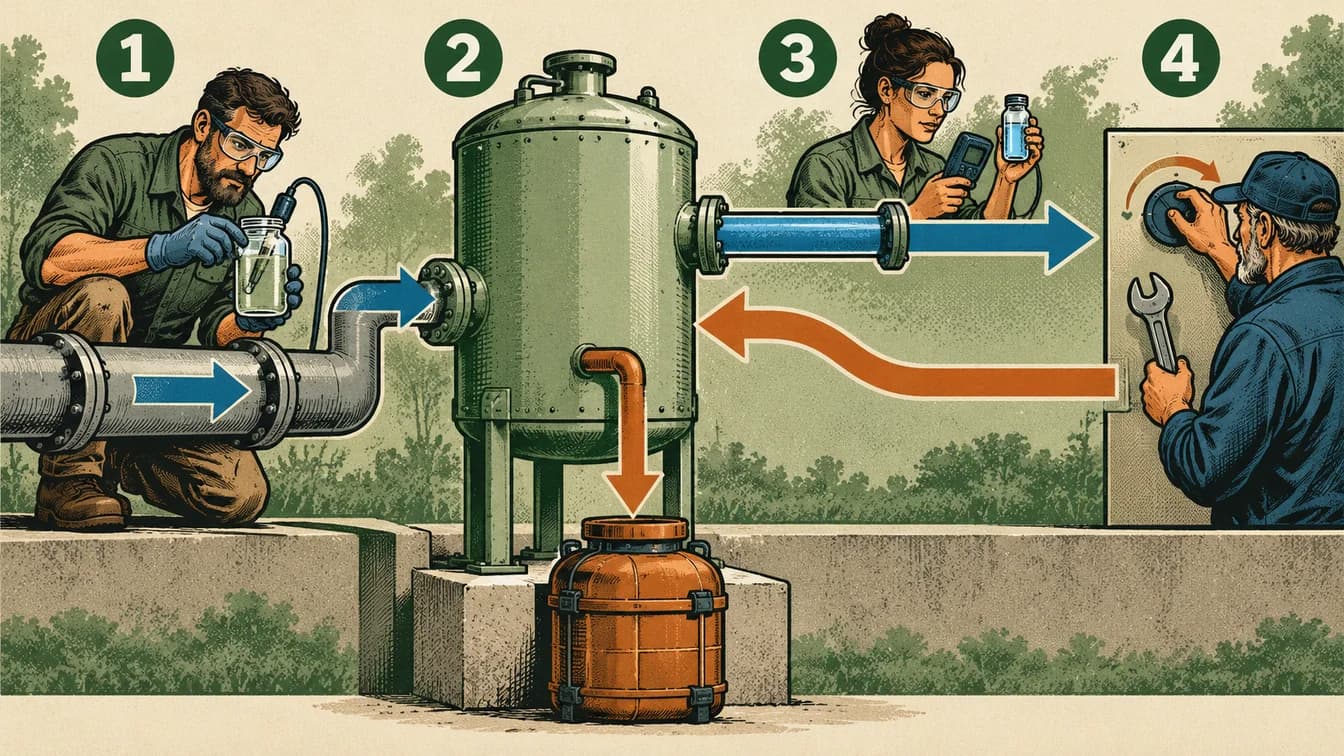
Measure the incoming water.
Apply treatment and account for residual material.
Test the main output against its intended use.
Use evidence to adjust operation and maintenance.
Blue arrows show the main water stream. The downward orange branch is residual material; the returning arrow is feedback. Neither clarity nor this illustration establishes drinking-water safety.
The lesson, in the real world
A treatment idea has to keep working when real water and operating conditions change.
- 1
Identify what is in the incoming water and what quality is required for the intended discharge or reuse.
Our explanation - 2
Select treatment steps that address the target substances. A biological reactor is one possible component, not a universal solution.
Our explanation - 3
Equipment, controls and maintenance must keep the process within suitable conditions.
Our explanation - 4
Measure the outgoing water and compare it with the requirement. A promising test is not the same as sustained operating performance.
Our explanation
Who does this work
Role
Instrumentation and controls
Keep a process measurable and responsive. Controls work connects sensors, decisions and actuators so the system can respond when conditions change.
What might you actually do?
Investigate
Check whether sensors are reading reliably.
Test and compare
Compare measurements with the intended operating range.
Explain and improve
Test how the system responds to a change or fault.
Typical of this kind of work in general. Not a description of any one person’s job at Integrated Sustainability.
- Often works with
- Operators, electricians and process engineers
- Classroom connection
- Feedback uses a measured result to inform the next action.
Related job postings
Similar work at other employers in Calgary, AB, not openings at Integrated Sustainability. These are live searches: results change daily and we have not checked them.
- Instrumentation technicianIndeed search for Instrumentation technician (opens in a new tab)Job Bank search for Instrumentation technician (opens in a new tab)
- Controls technicianIndeed search for Controls technician (opens in a new tab)Job Bank search for Controls technician (opens in a new tab)
- Controls engineerIndeed search for Controls engineer (opens in a new tab)Job Bank search for Controls engineer (opens in a new tab)
How to prepare
Instrumentation Engineering Technology
SAIT
Ways in
For your students
Ways to prepare for this work
Programs that teach skills this work uses. Each is one route in, not a requirement, and no program has endorsed this page.
Showing routes for instrumentation and controls. Show all
SAITDiplomaCalgary
Instrumentation Engineering Technology
Work with measurement devices, calibration and automated process controls.
About this route
Check the provider’s current prerequisites and intake availability. This is a related learning route, not a hiring promise or an employer requirement.
Why it connects to the work · our interpretation
Instrumentation and controlsSupports process testing, troubleshooting and control systems. Feedback uses a measured result to inform the next action.
Ask the class
Use it in class
Ask the class
What could change between a successful small trial and a full operating plant?
Compare two fictional plants with equal average output quality: one has stable results and one has large swings. Decide what additional operating records would help explain the difference.
Mindset it shows
Do not infer compliance from an average or equate all biological treatment processes. No claimed removal percentage is used.
About Integrated Sustainability

A treatment idea has to keep working when real water and operating conditions change.
- Headquarters
- Headquarters not separately verified for this example.
- Local connection
- Calgary engineering business; client treatment sites may be elsewhere.
- Source: Integrated Sustainability — company/project evidence 1(opens in a new tab); Integrated Sustainability — company/project evidence 2(opens in a new tab); Integrated Sustainability — company/project evidence 3(opens in a new tab); Integrated Sustainability — company/project evidence 4(opens in a new tab)
- Team size
- Not verified. We have not found a dated, sourced figure.
- The problem
- Why does a water-treatment system need more than a successful laboratory test?
- Source: Integrated Sustainability — company/project evidence 1(opens in a new tab); Integrated Sustainability — company/project evidence 2(opens in a new tab); Integrated Sustainability — company/project evidence 3(opens in a new tab); Integrated Sustainability — company/project evidence 4(opens in a new tab)
- What they do
- Water-infrastructure design, equipment delivery and operating services.
- Source: Integrated Sustainability — company/project evidence 1(opens in a new tab); Integrated Sustainability — company/project evidence 2(opens in a new tab); Integrated Sustainability — company/project evidence 3(opens in a new tab); Integrated Sustainability — company/project evidence 4(opens in a new tab)
- Who uses it
- Water-system owners and operators who need treatment equipment to work as a system.
- Source: Integrated Sustainability — company/project evidence 1(opens in a new tab); Integrated Sustainability — company/project evidence 2(opens in a new tab); Integrated Sustainability — company/project evidence 3(opens in a new tab); Integrated Sustainability — company/project evidence 4(opens in a new tab)
Integrated Sustainability is a Calgary-based water-infrastructure business working across design, equipment delivery and operations. Its public project material describes biological treatment of mine water and operating work on a moving bed biofilm reactor. Those are company project claims, not evidence that a mine or treatment plant is located in Calgary. The teaching focus is the connection between a treatment process and the system around it.
Source: Integrated Sustainability — company/project evidence 1(opens in a new tab); Integrated Sustainability — company/project evidence 2(opens in a new tab); Integrated Sustainability — company/project evidence 3(opens in a new tab); Integrated Sustainability — company/project evidence 4(opens in a new tab)Read each source’s date and scope: a documented role is not proof of a current vacancy or of where every position is based.
Reported as Integrated Sustainability states it. Integrated Sustainability has not reviewed or endorsed this page.
Sources and course fit
Sources checked 17 Oct 2026
Where it fits
- Chemistry 20 · Solutions, concentration and treatment evidence
Editorial mapping to published CBE course topics. Pending educator review. No outcome-code alignment is claimed.
Sources
- SAIT — Instrumentation Engineering Technology(opens in a new tab)
- SAIT — Integrated Water Management(opens in a new tab)
- Integrated Sustainability — company/project evidence 1(opens in a new tab)
- Integrated Sustainability — company/project evidence 2(opens in a new tab)
- Integrated Sustainability — company/project evidence 3(opens in a new tab)
- Integrated Sustainability — company/project evidence 4(opens in a new tab)
- Alberta Chemistry 20–30 program: solutions and concentration(opens in a new tab)
- University of Calgary — Chemical Engineering(opens in a new tab)
Organization claims are reported as the organization states them. Integrated Sustainability has not reviewed or endorsed this page.
What we know, and how
| Type | Claim | How we know |
|---|---|---|
| work | Integrated Sustainability is a Calgary-based water-infrastructure business working across design, equipment delivery and operations. Its public project material describes biological treatment of mine water and operating work on a moving bed biofilm reactor. Those are company project claims, not evidence that a mine or treatment plant is located in Calgary. The teaching focus is the connection between a treatment process and the system around it.Source: Integrated Sustainability — company/project evidence 1; Integrated Sustainability — company/project evidence 2; Integrated Sustainability — company/project evidence 3; Integrated Sustainability — company/project evidence 4 | Source-backed company/project account |
| local connection | Calgary engineering business; client treatment sites may be elsewhere.Source: Integrated Sustainability — company/project evidence 1; Integrated Sustainability — company/project evidence 2; Integrated Sustainability — company/project evidence 3; Integrated Sustainability — company/project evidence 4 | Source-backed local work |
| course fit | Chemistry 20 Unit C addresses aqueous solutions and concentration. Compare feed and output concentrations with flow and sample timing; process controls are an engineering extension.Source: Alberta Chemistry 20–30 program: solutions and concentration | Editorial application of verified curriculum topics |
| limits | The draft narrows the original generic treatment question to operating reliability. Omit “first”, efficiency and removal-rate marketing claims.Source: Integrated Sustainability — company/project evidence 1; Integrated Sustainability — company/project evidence 2; Integrated Sustainability — company/project evidence 3; Integrated Sustainability — company/project evidence 4 | Scope of this example |
Solid green: the organization states it. Outlined: seen in a dated source. Dashed: our interpretation, not yet researched, or announced but not yet real.