Classroom example ICE Western
Show your class · 1 of 5
The questionShow your class · 2 of 5
How it worksShow your class · 3 of 5
Who does this workShow your class · 4 of 5
Ways inShow your class · 5 of 5
Ask the classFor you
About ICE WesternFor you
SourcesHow can a building bring fresh air in without losing all its heat?
ICE Western · Employer identifies industrial manufacturing facility in Calgary's South Foothills.
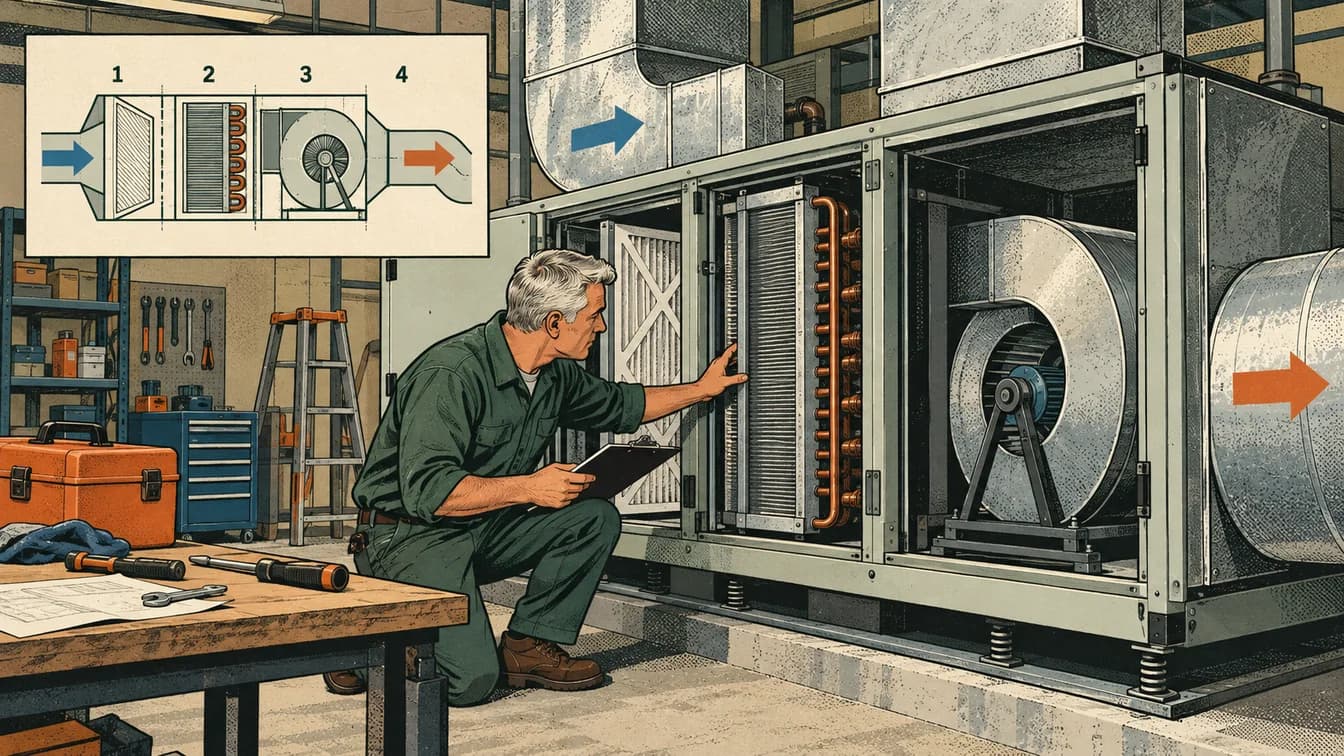
Where it fits
Pick your class- Science 10 · Unit B, outcome 3 — energy transfers in thermal devices
How it works
Schematic · not to scale
Fresh air can enter a building while some outgoing heat is recovered.
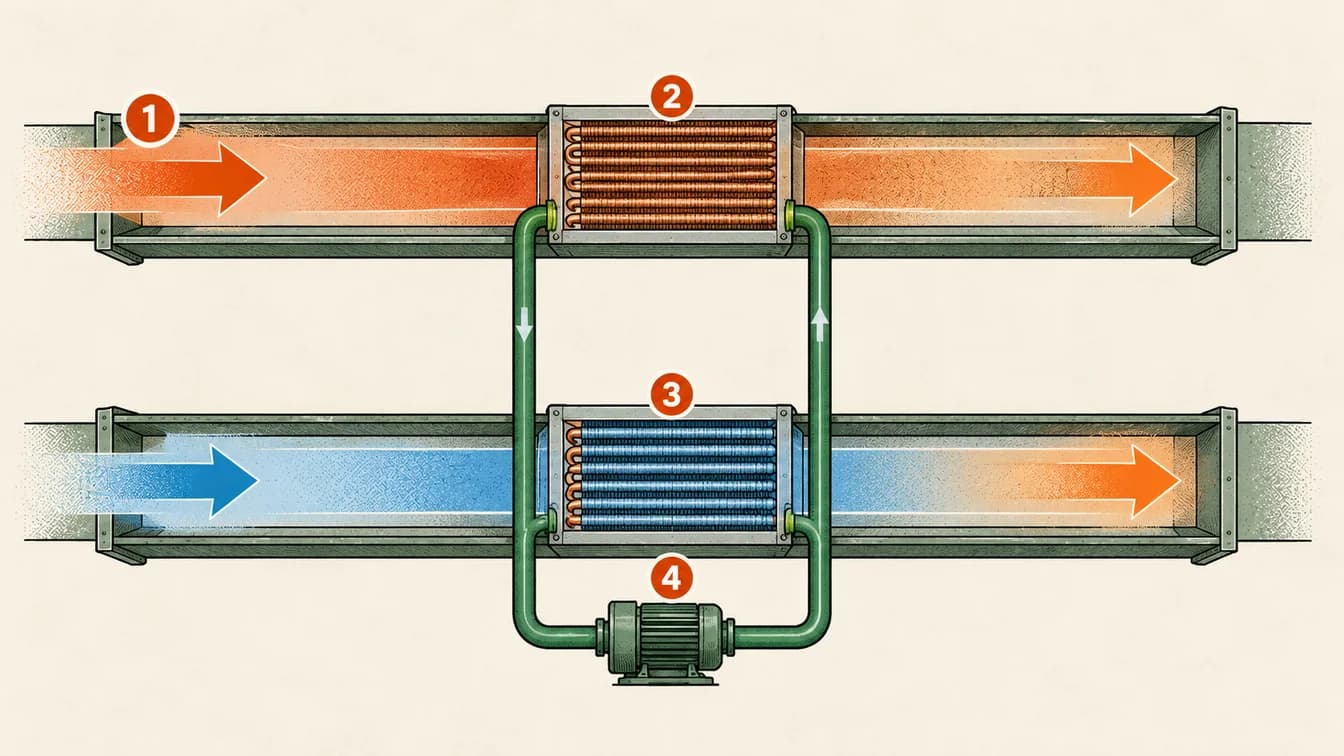
Warm exhaust air leaves a space while colder outdoor air enters in a winter example.
A coil in the exhaust path transfers some heat to a circulating fluid.
The fluid carries energy to a coil in the incoming-air path; the two air streams remain separate in this arrangement.
Fans and the circulation system also require energy. Recovery can reduce part of the heating demand without recovering every unit of heat.
This is a run-around heat-recovery model, not every type of HVAC system. Do not depict dirty exhaust mixing directly with supply air or claim that a heat exchanger is a refrigerator. No glycol concentrations or equipment sizing instructions are needed.
The lesson, in the real world
Fresh air can enter a building while some outgoing heat is recovered.
- 1
Warm exhaust air leaves a space while colder outdoor air enters in a winter example.
Our explanation - 2
A coil in the exhaust path transfers some heat to a circulating fluid.
Our explanation - 3
The fluid carries energy to a coil in the incoming-air path; the two air streams remain separate in this arrangement.
Our explanation - 4
Fans and the circulation system also require energy. Recovery can reduce part of the heating demand without recovering every unit of heat.
Our explanation
Who does this work
Role
Instrumentation and controls
Keep a process measurable and responsive. Controls work connects sensors, decisions and actuators so the system can respond when conditions change.
What might you actually do?
Investigate
Check whether sensors are reading reliably.
Test and compare
Compare measurements with the intended operating range.
Explain and improve
Test how the system responds to a change or fault.
Typical of this kind of work in general. Not a description of any one person’s job at ICE Western.
- Often works with
- Operators, electricians and process engineers
- Classroom connection
- Feedback uses a measured result to inform the next action.
Related job postings
Similar work at other employers in Calgary, AB, not openings at ICE Western. These are live searches: results change daily and we have not checked them.
- Instrumentation technicianIndeed search for Instrumentation technician (opens in a new tab)Job Bank search for Instrumentation technician (opens in a new tab)
- Controls technicianIndeed search for Controls technician (opens in a new tab)Job Bank search for Controls technician (opens in a new tab)
- Controls engineerIndeed search for Controls engineer (opens in a new tab)Job Bank search for Controls engineer (opens in a new tab)
How to prepare
Mechanical Engineering Technology
SAIT
Instrumentation Engineering Technology
SAIT
Ways in
For your students
Ways to prepare for this work
Programs that teach skills this work uses. Each is one route in, not a requirement, and no program has endorsed this page.
Showing routes for instrumentation and controls. Show all
SAITDiplomaCalgary
Mechanical Engineering Technology
Design, modelling and mechanical-system analysis.
About this route
A technical route; does not itself confer professional engineer registration. Check current admissions and intake before applying; this draft does not promise entry or employment.
Why it connects to the work · our interpretation
Instrumentation and controlsDesign, modelling and mechanical-system analysis. A reading depends on where and how it was measured, not just the number displayed.
SAITDiplomaCalgary
Instrumentation Engineering Technology
Measurement, calibration and process controls.
About this route
Related to sensor/control work; no guaranteed employer placement. Check current admissions and intake before applying; this draft does not promise entry or employment.
Why it connects to the work · our interpretation
Instrumentation and controlsMeasurement, calibration and process controls. A reading depends on where and how it was measured, not just the number displayed.
Ask the class
Use it in class
Ask the class
Why might a designer choose separate air streams even if a simpler arrangement seemed easier to build?
Sketch exhaust at 20°C and outdoor air at −10°C, without assigning an output temperature. Mark energy-flow directions and list the measurements needed to estimate recovery. Identify why flow rates matter as well as temperature.
Mindset it shows
This is a run-around heat-recovery model, not every type of HVAC system. Do not depict dirty exhaust mixing directly with supply air or claim that a heat exchanger is a refrigerator. No glycol concentrations or equipment sizing instructions are needed.
About ICE Western

Fresh air can enter a building while some outgoing heat is recovered.
- Headquarters
- Headquarters not separately verified for this example.
- Local connection
- Employer identifies industrial manufacturing facility in Calgary's South Foothills.
- Source: icewestern.com — official website(opens in a new tab); icewestern.com — Glycol_Runaround.pdf(opens in a new tab); icewestern.com — careers(opens in a new tab)
- Team size
- Not verified. We have not found a dated, sourced figure.
- The problem
- How can a building bring fresh air in without losing all its heat?
- Source: icewestern.com — official website(opens in a new tab); icewestern.com — Glycol_Runaround.pdf(opens in a new tab); icewestern.com — careers(opens in a new tab)
- What they do
- Make custom HVAC and heat-recovery equipment.
- Source: icewestern.com — official website(opens in a new tab); icewestern.com — Glycol_Runaround.pdf(opens in a new tab); icewestern.com — careers(opens in a new tab)
- Who uses it
- Building and industrial operators managing ventilation and temperature requirements.
- Source: icewestern.com — official website(opens in a new tab); icewestern.com — Glycol_Runaround.pdf(opens in a new tab); icewestern.com — careers(opens in a new tab)
ICE Western describes a manufacturing facility in Calgary's South Foothills and products for custom air handling and heat recovery. An employer-hosted technical catalogue describes a run-around arrangement using coils connected by a circulating liquid loop. That arrangement provides a specific teaching model: transfer heat between air streams while keeping the streams separate. The archived catalogue is technical context, not proof of today's orderable configuration.
Source: icewestern.com — official website(opens in a new tab); icewestern.com — Glycol_Runaround.pdf(opens in a new tab); icewestern.com — careers(opens in a new tab)Read each source’s date and scope: a documented role is not proof of a current vacancy or of where every position is based.
Reported as ICE Western states it. ICE Western has not reviewed or endorsed this page.
Sources and course fit
Sources checked 18 Oct 2026
Where it fits
- Science 10 · Unit B, outcome 3 — energy transfers in thermal devices
Editorial mapping to published CBE course topics. Pending educator review. No outcome-code alignment is claimed.
Sources
- icewestern.com — official website(opens in a new tab)
- icewestern.com — Glycol_Runaround.pdf(opens in a new tab)
- icewestern.com — careers(opens in a new tab)
- SAIT — Refrigeration and Air Conditioning Mechanic(opens in a new tab)
- SAIT — Mechanical Engineering Technology(opens in a new tab)
- SAIT — Instrumentation Engineering Technology(opens in a new tab)
- education.alberta.ca — science10.pdf(opens in a new tab)
Organization claims are reported as the organization states them. ICE Western has not reviewed or endorsed this page.
What we know, and how
| Type | Claim | How we know |
|---|---|---|
| work | ICE Western describes a manufacturing facility in Calgary's South Foothills and products for custom air handling and heat recovery. An employer-hosted technical catalogue describes a run-around arrangement using coils connected by a circulating liquid loop. That arrangement provides a specific teaching model: transfer heat between air streams while keeping the streams separate. The archived catalogue is technical context, not proof of today's orderable configuration.Source: icewestern.com — official website; icewestern.com — Glycol_Runaround.pdf; icewestern.com — careers | Company-stated work with source limits preserved |
| local connection | Employer identifies industrial manufacturing facility in Calgary's South Foothills.Source: icewestern.com — official website; icewestern.com — Glycol_Runaround.pdf; icewestern.com — careers | Source-backed Calgary connection |
| course fit | Direct thermal-system and efficiency connection. Coil sizing, airflow design and commercial ventilation requirements are extensions.Source: education.alberta.ca — science10.pdf | Editorial application of source-checked curriculum concepts |
| limits | Catalogue path is historical (2011); use only its general heat-transfer relationship. Confirm current product configuration before any branded technical claim. Science 10 badge refers to energy concepts, not trade qualification.Source: icewestern.com — official website; icewestern.com — Glycol_Runaround.pdf; icewestern.com — careers | Scope of this example |
Solid green: the organization states it. Outlined: seen in a dated source. Dashed: our interpretation, not yet researched, or announced but not yet real.