Classroom example CPKC
Show your class · 1 of 5
The questionShow your class · 2 of 5
How it worksShow your class · 3 of 5
Who does this workShow your class · 4 of 5
Ways inShow your class · 5 of 5
Ask the classFor you
About CPKCFor you
SourcesHow can trains share a rail network without getting in each other’s way?
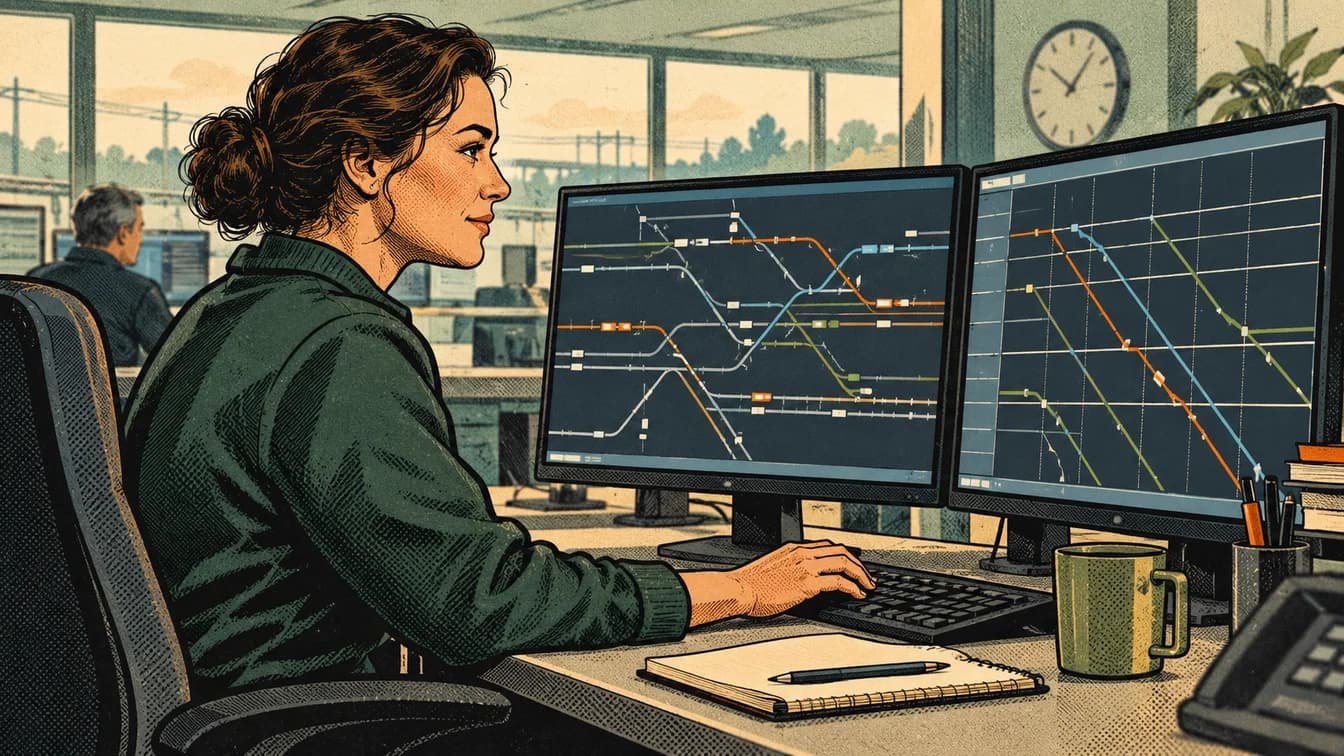
CPKC · Calgary operations centre and dispatch function are documented in the 2025 annual report.
Where it fits
Pick your class- Physics 20 · Position-time graphs and motion
How it works
Schematic · not to scale
Compare movements in space and time
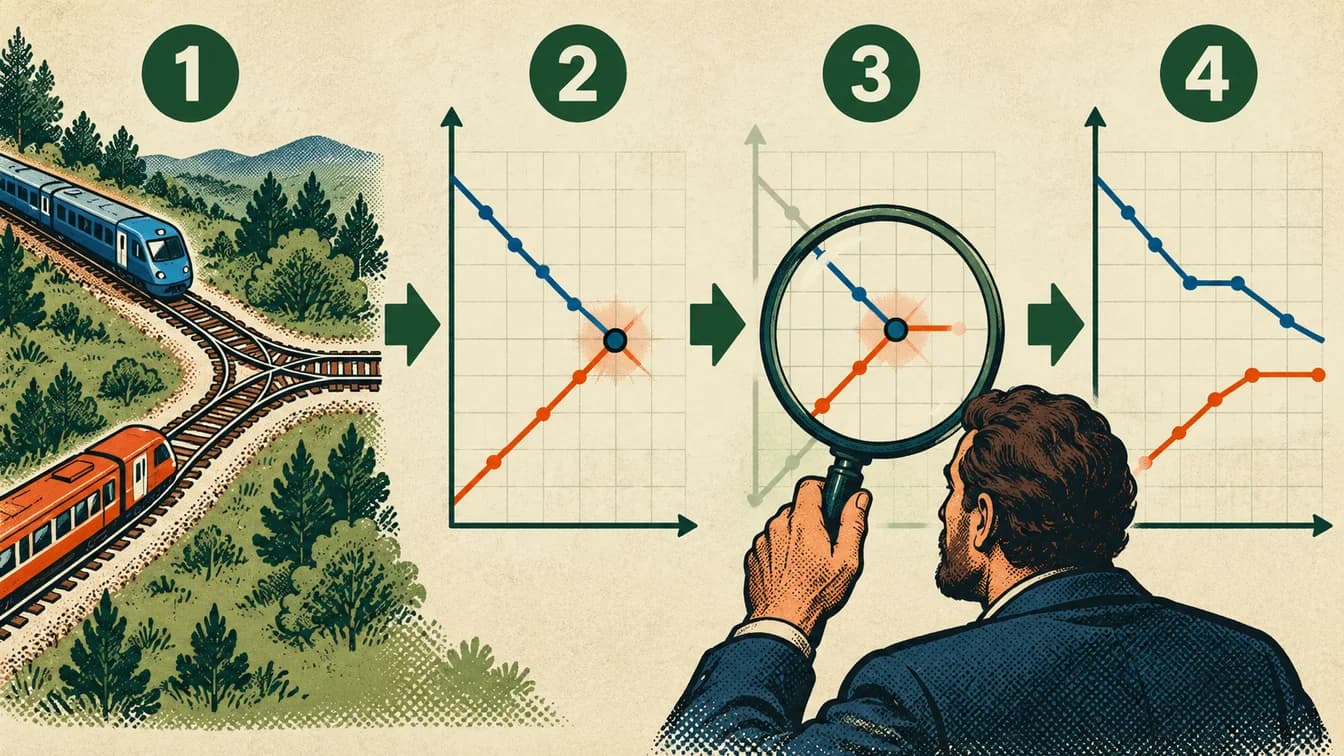
Identify movements that need a shared corridor.
Compare position against time for each movement.
Look for a possible conflict in the same space and time.
Revise the plan and check it again.
Horizontal axis: time; vertical axis: position. The charts are fictional and cover only the illustrated interval. They are not dispatch instructions or proof a complete railway plan is safe.
The lesson, in the real world
A railway moves through space, but its plan also has to work through time.
- 1
Two trains can need the same section of track at different times. Distance alone does not reveal a conflict.
Our explanation - 2
A time-distance diagram lets a planner compare movement and waiting in one view.
Our explanation - 3
Changing one train’s departure may affect several later movements. Plans have to consider constraints together.
Our explanation - 4
Real rail operations use formal rules, communication and trained staff. A classroom timetable illustrates only one part of that system.
Our explanation
Who does this work
Role
Software and data systems
Build the tools that move, process and display information. Reliable software needs testing against missing, delayed and unexpected data as well as ideal examples.
What might you actually do?
Investigate
Translate a user need into a testable behaviour.
Test and compare
Build and test a data-processing or display feature.
Explain and improve
Investigate failures and document assumptions about inputs.
Typical of this kind of work in general. Not a description of any one person’s job at CPKC.
- Often works with
- Domain experts, designers, users and hardware teams
- Classroom connection
- An algorithm’s output depends on the quality and meaning of its inputs.
Related job postings
Similar work at other employers in Calgary, AB, not openings at CPKC. These are live searches: results change daily and we have not checked them.
How to prepare
Software Development
SAIT
Ways in
For your students
Ways to prepare for this work
Programs that teach skills this work uses. Each is one route in, not a requirement, and no program has endorsed this page.
Showing routes for software and data systems. Show all
SAITDiplomaCalgary
Software Development
Learn to design, test and build software across front-end and back-end systems.
About this route
Check the provider’s current prerequisites and intake availability. This is a related learning route, not a hiring promise or an employer requirement.
Why it connects to the work · our interpretation
Software and data systemsA foundation for junior development or testing; senior roles require further experience. An algorithm’s output depends on the quality and meaning of its inputs.
Ask the class
Use it in class
Ask the class
What happens to the rest of a timetable when one train is delayed?
On a fictional single-track segment, Train A occupies it from minute 0 to 8 and Train B from minute 5 to 12. Shift B to remove overlap, then discuss what additional safety margin would need a real rule rather than a guess.
Mindset it shows
This is a scheduling puzzle, not a safe operating procedure. Do not invent braking distances or dispatch clearances.
About CPKC

A railway moves through space, but its plan also has to work through time.
- Headquarters
- Headquarters not separately verified for this example.
- Local connection
- Calgary operations centre and dispatch function are documented in the 2025 annual report.
- Source: CPKC — company/project evidence 1(opens in a new tab); CPKC — company/project evidence 2(opens in a new tab); CPKC — company/project evidence 3(opens in a new tab); CPKC — company/project evidence 4(opens in a new tab)
- Team size
- Not verified. We have not found a dated, sourced figure.
- The problem
- How can trains share a rail network without getting in each other’s way?
- Source: CPKC — company/project evidence 1(opens in a new tab); CPKC — company/project evidence 2(opens in a new tab); CPKC — company/project evidence 3(opens in a new tab); CPKC — company/project evidence 4(opens in a new tab)
- What they do
- Rail transportation supported by operations planning and network coordination.
- Source: CPKC — company/project evidence 1(opens in a new tab); CPKC — company/project evidence 2(opens in a new tab); CPKC — company/project evidence 3(opens in a new tab); CPKC — company/project evidence 4(opens in a new tab)
- Who uses it
- Businesses moving freight and the crews coordinating train movements.
- Source: CPKC — company/project evidence 1(opens in a new tab); CPKC — company/project evidence 2(opens in a new tab); CPKC — company/project evidence 3(opens in a new tab); CPKC — company/project evidence 4(opens in a new tab)
CPKC operates a rail network across Canada, the United States and Mexico. Its 2025 annual report identifies Calgary as the location of its main operations centre and primary Canadian dispatch facility. Rail traffic controllers coordinate crews and day-to-day locomotive operations. The classroom model below simplifies the scheduling problem; it does not describe railway operating rules.
Source: CPKC — company/project evidence 1(opens in a new tab); CPKC — company/project evidence 2(opens in a new tab); CPKC — company/project evidence 3(opens in a new tab); CPKC — company/project evidence 4(opens in a new tab)Read each source’s date and scope: a documented role is not proof of a current vacancy or of where every position is based.
Reported as CPKC states it. CPKC has not reviewed or endorsed this page.
Sources and course fit
Sources checked 17 Oct 2026
Where it fits
- Physics 20 · Position-time graphs and motion
Editorial mapping to published CBE course topics. Pending educator review. No outcome-code alignment is claimed.
Sources
- Alberta Physics 20–30 performance standards: A1, B1 and C1(opens in a new tab)
- CPKC — company/project evidence 1(opens in a new tab)
- CPKC — company/project evidence 2(opens in a new tab)
- CPKC — company/project evidence 3(opens in a new tab)
- CPKC — company/project evidence 4(opens in a new tab)
- SAIT — Railway Conductor(opens in a new tab)
- SAIT — Software Development(opens in a new tab)
Organization claims are reported as the organization states them. CPKC has not reviewed or endorsed this page.
What we know, and how
| Type | Claim | How we know |
|---|---|---|
| work | CPKC operates a rail network across Canada, the United States and Mexico. Its 2025 annual report identifies Calgary as the location of its main operations centre and primary Canadian dispatch facility. Rail traffic controllers coordinate crews and day-to-day locomotive operations. The classroom model below simplifies the scheduling problem; it does not describe railway operating rules.Source: CPKC — company/project evidence 1; CPKC — company/project evidence 2; CPKC — company/project evidence 3; CPKC — company/project evidence 4 | Source-backed company/project account |
| local connection | Calgary operations centre and dispatch function are documented in the 2025 annual report.Source: CPKC — company/project evidence 1; CPKC — company/project evidence 2; CPKC — company/project evidence 3; CPKC — company/project evidence 4 | Source-backed local work |
| course fit | Physics 20 A1 supports interpreting position-time graphs. Compare fictional movements; timetable decisions and railway rules are extensions beyond the classroom model.Source: Alberta Physics 20–30 performance standards: A1, B1 and C1 | Editorial application of verified curriculum topics |
| limits | Controller entry is represented by a historical employer-training example, not a current vacancy or guaranteed six-month intake. SAIT Railway Conductor leads toward conductor work, not controller qualification. Older agreement terms are not treated as current.Source: CPKC — company/project evidence 1; CPKC — company/project evidence 2; CPKC — company/project evidence 3; CPKC — company/project evidence 4 | Scope of this example |
Solid green: the organization states it. Outlined: seen in a dated source. Dashed: our interpretation, not yet researched, or announced but not yet real.