Classroom example Congebec
Show your class · 1 of 5
The questionShow your class · 2 of 5
How it worksShow your class · 3 of 5
Who does this workShow your class · 4 of 5
Ways inShow your class · 5 of 5
Ask the classFor you
About CongebecFor you
SourcesHow do you keep food cold while moving it through a busy warehouse?
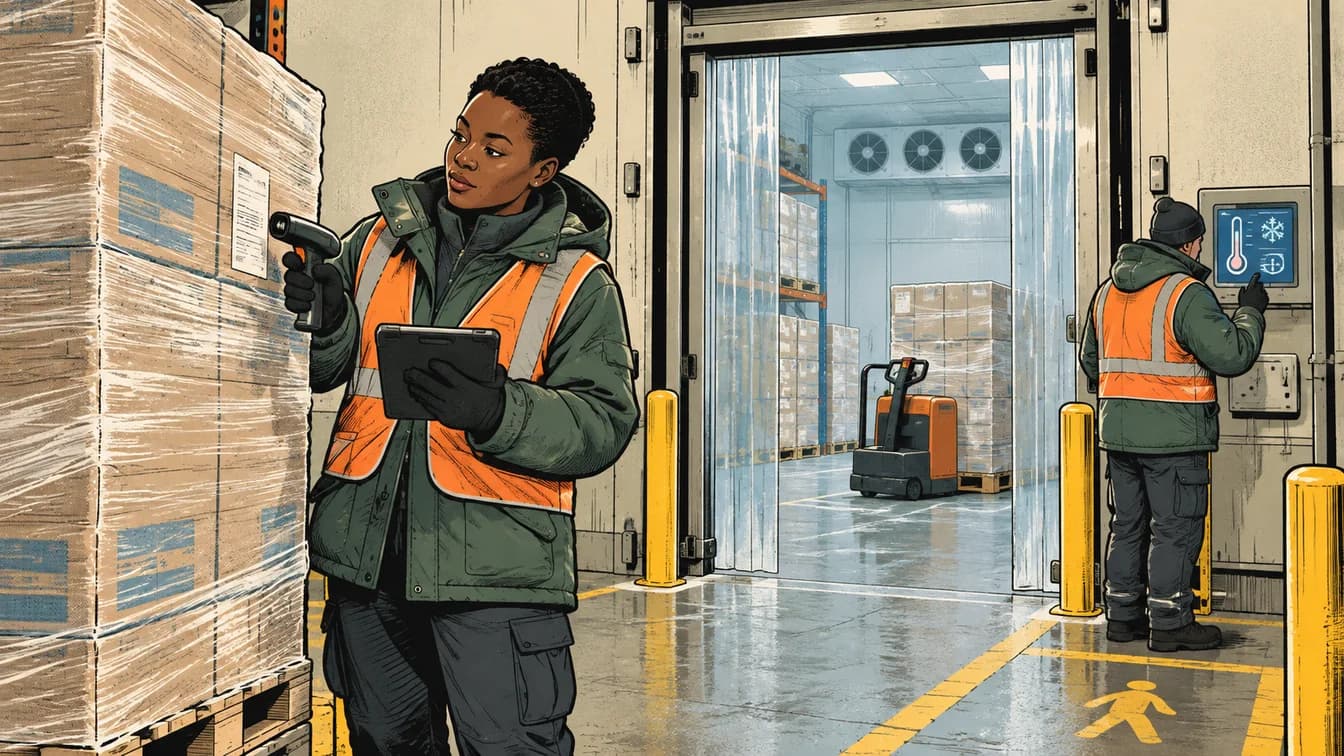
Congebec · Operating cold-storage location listed at 5500 72 Avenue SE, Calgary.
Where it fits
Pick your class- Science 10 · Unit B, outcome 3 — refrigeration and energy transfers
How it works
Schematic · not to scale
Cold storage is an ongoing heat-management problem, not a one-time act of cooling.
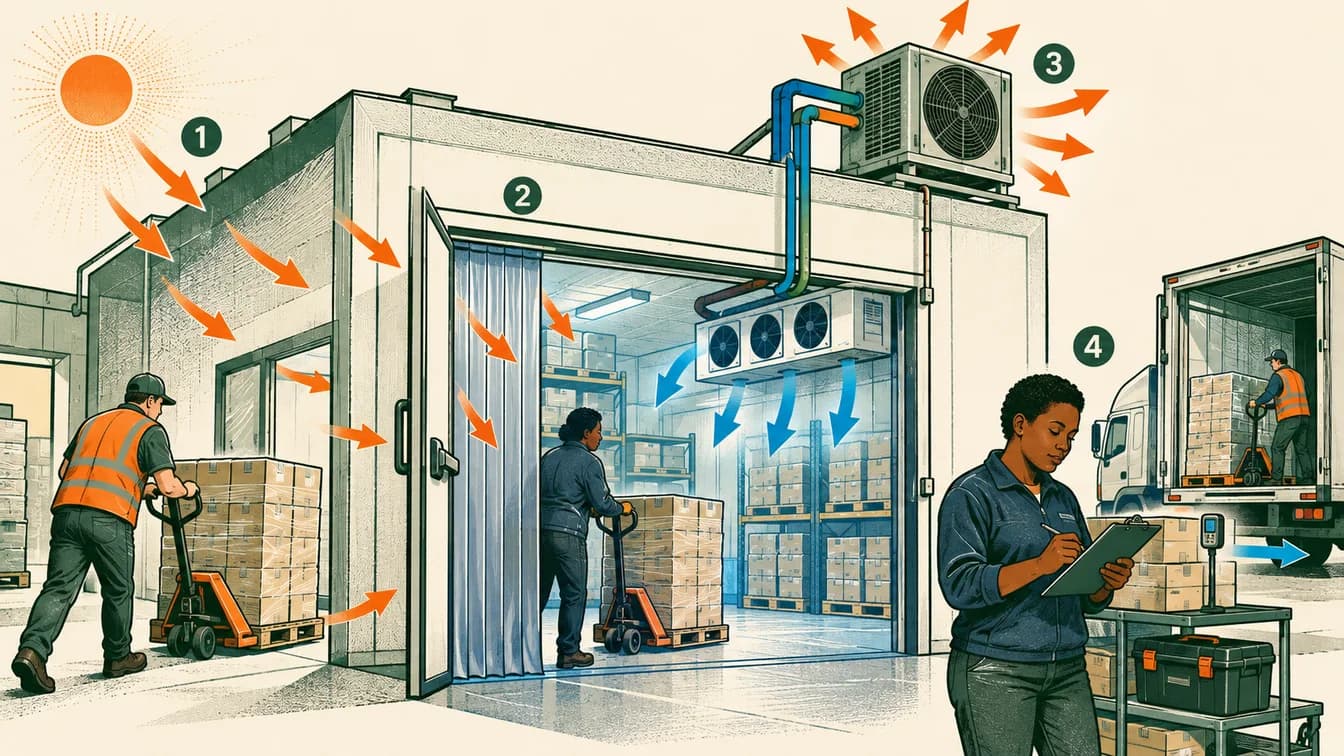
A refrigerated space receives heat from its surroundings, incoming goods and everyday activity.
Insulation and careful door/handling practices affect how quickly heat enters.
Refrigeration transfers heat out of the cooled space and rejects it elsewhere, using energy to do so.
People coordinate product movements, measurements and equipment maintenance. A recorded room temperature is only one piece of evidence about a product's journey.
No food-storage temperatures or safe holding times are prescribed. Refrigeration moves heat; it does not destroy energy. Room-air, product-core and transport temperatures should not be treated as interchangeable.
The lesson, in the real world
Cold storage is an ongoing heat-management problem, not a one-time act of cooling.
- 1
A refrigerated space receives heat from its surroundings, incoming goods and everyday activity.
Our explanation - 2
Insulation and careful door/handling practices affect how quickly heat enters.
Our explanation - 3
Refrigeration transfers heat out of the cooled space and rejects it elsewhere, using energy to do so.
Our explanation - 4
People coordinate product movements, measurements and equipment maintenance. A recorded room temperature is only one piece of evidence about a product's journey.
Our explanation
Who does this work
Role
Warehouse and inventory operations
Receive, locate and move goods while keeping identity and handling requirements visible.
What might you actually do?
Check
Check incoming goods against shipment information.
Move
Move and store products using appropriate equipment and procedures.
Maintain
Maintain inventory records and coordinate outbound loads.
Typical of this kind of work in general. Not a description of any one person’s job at Congebec.
- Often works with
- DriversDispatchFood-quality teams
- Classroom connection
- Temperature, time and correct identification all matter to a cold chain.
Related job postings
Similar work at other employers in Calgary, AB, not openings at Congebec. These are live searches: results change daily and we have not checked them.
How to prepare
Business Administration — Supply Chain Management
SAIT
Ways in
For your students
Ways to prepare for this work
Programs that teach skills this work uses. Each is one route in, not a requirement, and no program has endorsed this page.
Showing routes for warehouse and inventory operations. Show all
SAITDiplomaCalgary
Business Administration — Supply Chain Management
Supply-chain coordination, operations and planning.
About this route
A possible progression route, not a required credential for every warehouse role. Check current admissions and intake before applying; this draft does not promise entry or employment.
Why it connects to the work · our interpretation
Warehouse and inventory operationsSupply-chain coordination, operations and planning. Temperature, time and correct identification all matter to a cold chain.
Ask the class
Use it in class
Ask the class
Would a cold room reading prove that every product inside had been handled correctly?
Compare two fictional warehouse plans: one leaves a loading door open continuously; the other groups transfers into short windows. Identify likely heat pathways, an operational trade-off, and measurements needed before predicting energy savings.
Mindset it shows
No food-storage temperatures or safe holding times are prescribed. Refrigeration moves heat; it does not destroy energy. Room-air, product-core and transport temperatures should not be treated as interchangeable.
About Congebec

Cold storage is an ongoing heat-management problem, not a one-time act of cooling.
- Headquarters
- Headquarters not separately verified for this example.
- Local connection
- Operating cold-storage location listed at 5500 72 Avenue SE, Calgary.
- Source: congebec.com — locations(opens in a new tab); congebec.com — en(opens in a new tab); congebec.com — careers 3(opens in a new tab); congebec.com — job postings(opens in a new tab)
- Team size
- Not verified. We have not found a dated, sourced figure.
- The problem
- How do you keep food cold while moving it through a busy warehouse?
- Source: congebec.com — locations(opens in a new tab); congebec.com — en(opens in a new tab); congebec.com — careers 3(opens in a new tab); congebec.com — job postings(opens in a new tab)
- What they do
- Store and move temperature-controlled food.
- Source: congebec.com — locations(opens in a new tab); congebec.com — en(opens in a new tab); congebec.com — careers 3(opens in a new tab); congebec.com — job postings(opens in a new tab)
- Who uses it
- Food producers, distributors and the people who depend on temperature-controlled supply chains.
- Source: congebec.com — locations(opens in a new tab); congebec.com — en(opens in a new tab); congebec.com — careers 3(opens in a new tab); congebec.com — job postings(opens in a new tab)
Congebec operates temperature-controlled food-storage facilities, including the listed Calgary location on 72 Avenue SE. Its career information describes warehouse, inventory, refrigeration and logistics work. The example focuses on keeping products moving while managing heat entering storage. A separately announced rail-linked Calgary development is not presented as an operating facility.
Source: congebec.com — locations(opens in a new tab); congebec.com — en(opens in a new tab); congebec.com — careers 3(opens in a new tab); congebec.com — job postings(opens in a new tab)Read each source’s date and scope: a documented role is not proof of a current vacancy or of where every position is based.
Reported as Congebec states it. Congebec has not reviewed or endorsed this page.
Sources and course fit
Sources checked 18 Oct 2026
Where it fits
- Science 10 · Unit B, outcome 3 — refrigeration and energy transfers
Editorial mapping to published CBE course topics. Pending educator review. No outcome-code alignment is claimed.
Sources
- congebec.com — locations(opens in a new tab)
- congebec.com — en(opens in a new tab)
- congebec.com — careers 3(opens in a new tab)
- congebec.com — job postings(opens in a new tab)
- SAIT — Refrigeration and Air Conditioning Mechanic(opens in a new tab)
- SAIT — Business Administration — Supply Chain Management(opens in a new tab)
- education.alberta.ca — science10.pdf(opens in a new tab)
Organization claims are reported as the organization states them. Congebec has not reviewed or endorsed this page.
What we know, and how
| Type | Claim | How we know |
|---|---|---|
| work | Congebec operates temperature-controlled food-storage facilities, including the listed Calgary location on 72 Avenue SE. Its career information describes warehouse, inventory, refrigeration and logistics work. The example focuses on keeping products moving while managing heat entering storage. A separately announced rail-linked Calgary development is not presented as an operating facility.Source: congebec.com — locations; congebec.com — en; congebec.com — careers 3; congebec.com — job postings | Company-stated work with source limits preserved |
| local connection | Operating cold-storage location listed at 5500 72 Avenue SE, Calgary.Source: congebec.com — locations; congebec.com — en; congebec.com — careers 3; congebec.com — job postings | Source-backed Calgary connection |
| course fit | The program explicitly includes refrigerators and heat pumps as technological systems. Cold-chain quality and operational scheduling extend the context.Source: education.alberta.ca — science10.pdf | Editorial application of source-checked curriculum concepts |
| limits | Use the existing listed Calgary warehouse, not the proposed CN-linked expansion. The supply-chain diploma is a progression option, not a minimum for every warehouse job.Source: congebec.com — locations; congebec.com — en; congebec.com — careers 3; congebec.com — job postings | Scope of this example |
Solid green: the organization states it. Outlined: seen in a dated source. Dashed: our interpretation, not yet researched, or announced but not yet real.