Classroom example Carbonova
Show your class · 1 of 5
The questionShow your class · 2 of 5
How it worksShow your class · 3 of 5
Who does this workShow your class · 4 of 5
Ways inShow your class · 5 of 5
Ask the classFor you
About CarbonovaFor you
SourcesHow can carbon-containing gases become useful solid materials?
Carbonova · Calgary pilot and demonstration-project evidence; the larger demonstration unit is not described here as commissioned.
Where it fits
Pick your class- Chemistry 20 · Matter conservation and chemical changes
- Science 30 · Chemistry and the environment
How it works
Schematic · not to scale
Track carbon through a process
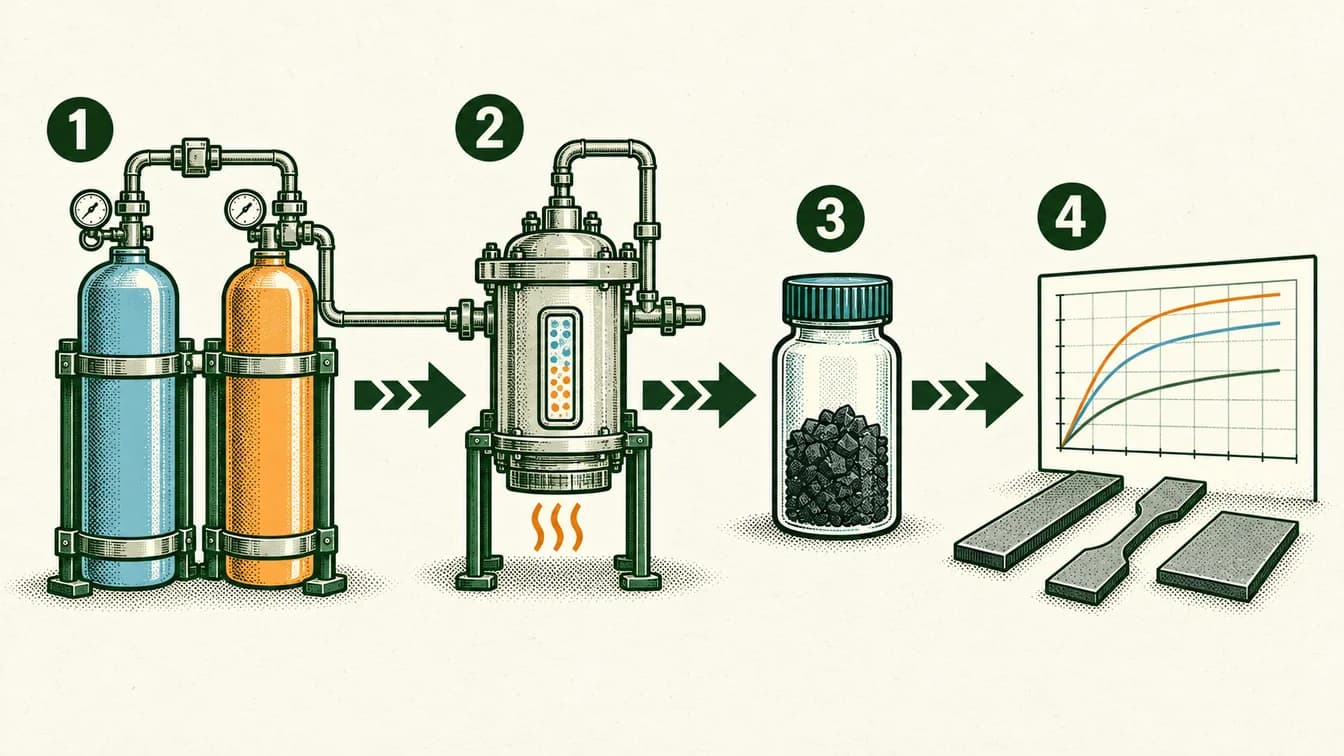
Supply carbon-containing gases to the process.
Use controlled reaction conditions.
Recover solid carbon material.
Measure its properties and the process inputs and outputs.
The chart is illustrative, not measured results. This is not a balanced reaction diagram. Energy use and other streams matter when evaluating environmental claims.
The lesson, in the real world
Carbon atoms can become part of a different material.
- 1
Carbon-containing feedstocks supply atoms that can become part of a solid product through a sequence of chemical processes.
Our explanation - 2
ERA’s project account describes reforming followed by a carbonization reactor that produces solid carbon material.
Our explanation - 3
The resulting nanofibres can be tested as additives. Compare a material with and without the additive under the same conditions.
Our explanation - 4
Also examine the inputs, energy and remaining outputs. A useful product and a lower overall environmental footprint are related but separate claims.
Our explanation
Who does this work
Role
Laboratory analysis
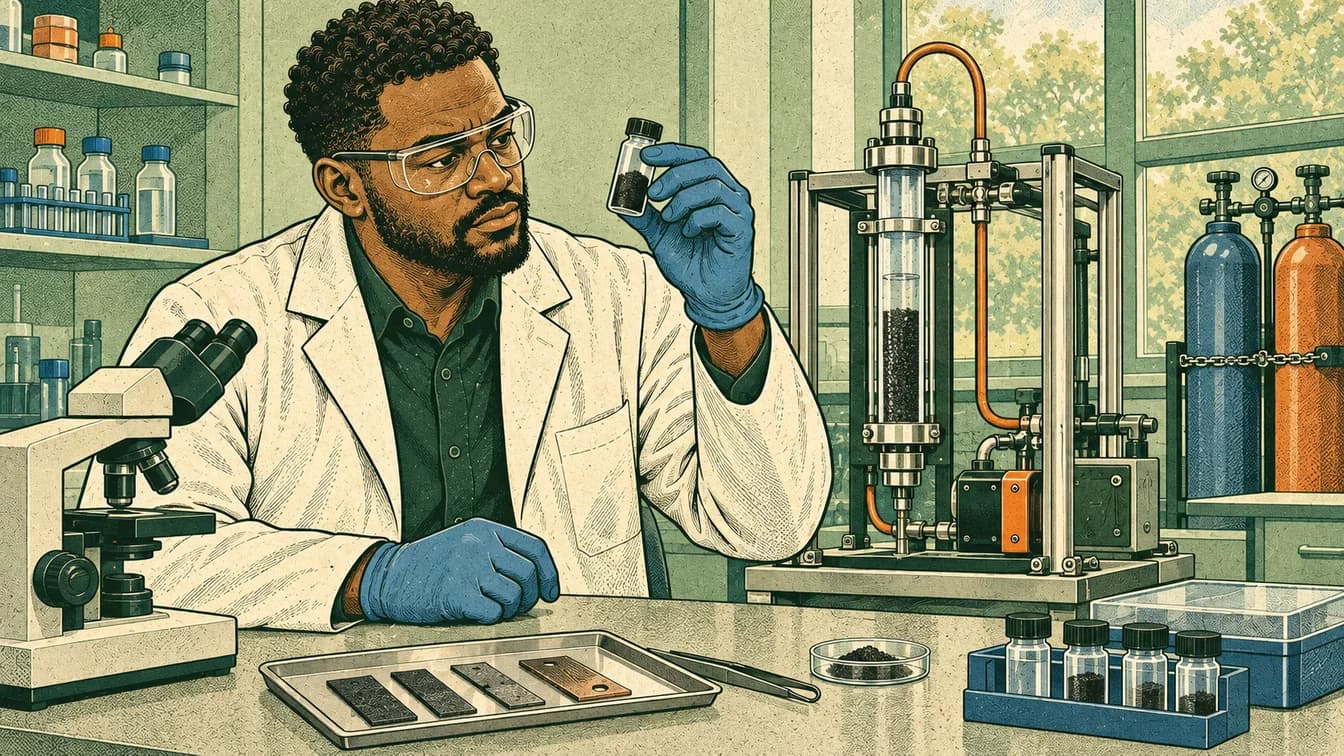
Make measurements that other people can trust. A laboratory worker prepares samples, uses a method consistently and records enough detail for someone else to interpret the result.
What might you actually do?
Investigate
Prepare and label samples so their identity is preserved.
Test and compare
Run comparisons or reference samples to check the method.
Explain and improve
Record results, units and limitations before sharing findings.
Typical of this kind of work in general. Not a description of any one person’s job at Carbonova.
- Often works with
- Scientists, process engineers and quality teams
- Classroom connection
- A repeatable method and a fair comparison matter as much as a single impressive number.
Related job postings
Similar work at other employers in Calgary, AB, not openings at Carbonova. These are live searches: results change daily and we have not checked them.
- Laboratory technicianIndeed search for Laboratory technician (opens in a new tab)Job Bank search for Laboratory technician (opens in a new tab)
- Laboratory technologistIndeed search for Laboratory technologist (opens in a new tab)Job Bank search for Laboratory technologist (opens in a new tab)
- Lab analystIndeed search for Lab analyst (opens in a new tab)Job Bank search for Lab analyst (opens in a new tab)
How to prepare
Chemical Laboratory Technology
SAIT
Ways in
For your students
Ways to prepare for this work
Programs that teach skills this work uses. Each is one route in, not a requirement, and no program has endorsed this page.
Showing routes for laboratory analysis. Show all
SAITDiplomaCalgary
Chemical Laboratory Technology
Practice chemical analysis, sample preparation and analytical instrumentation.
About this route
Check the provider’s current prerequisites and intake availability. This is a related learning route, not a hiring promise or an employer requirement.
Why it connects to the work · our interpretation
Laboratory analysisSupports laboratory testing and reliable measurement. A repeatable method and a fair comparison matter as much as a single impressive number.
Ask the class
Use it in class
Ask the class
What would you measure to decide whether a new additive improves both performance and environmental impact?
Provide fictional strength-test results for identical samples with two additive amounts. Ask students to compare variation, identify a control and list the additional evidence required for an environmental claim.
Mindset it shows
A stronger sample alone cannot establish lower lifecycle emissions. No claim is made that these invented values are Carbonova test results.
About Carbonova

Carbon atoms can become part of a different material.
- Headquarters
- Calgary pilot and demonstration-project evidence; the larger demonstration unit is not described here as commissioned.
- Source: Company technology and development status(opens in a new tab); Active Calgary demonstration project(opens in a new tab); Completed CREATE process project(opens in a new tab)
- Local connection
- Calgary pilot and demonstration-project evidence; the larger demonstration unit is not described here as commissioned.
- Source: Company technology and development status(opens in a new tab); Active Calgary demonstration project(opens in a new tab); Completed CREATE process project(opens in a new tab)
- Team size
- Not verified. We have not found a dated, sourced figure.
- The problem
- Can a carbon-containing gas become an additive with useful material properties?
- Source: Company technology and development status(opens in a new tab); Active Calgary demonstration project(opens in a new tab); Completed CREATE process project(opens in a new tab)
- What they do
- Carbon nanofibre technology and material development for applications such as composites and construction materials.
- Source: Company technology and development status(opens in a new tab); Active Calgary demonstration project(opens in a new tab); Completed CREATE process project(opens in a new tab)
- Who uses it
- Material and product developers evaluating additives for a specific performance requirement.
- Source: Company technology and development status(opens in a new tab); Active Calgary demonstration project(opens in a new tab); Completed CREATE process project(opens in a new tab)
Carbonova develops a catalytic process that uses carbon-containing gases to make carbon nanofibres. Emissions Reduction Alberta documents Calgary pilot work and a separate commercial-demonstration project. The example focuses on converting feedstocks and testing a material’s usefulness, rather than assuming that using an emission stream automatically delivers a net climate benefit.
Source: Company technology and development status(opens in a new tab); Active Calgary demonstration project(opens in a new tab); Completed CREATE process project(opens in a new tab)Read each source’s date and scope: a documented role is not proof of a current vacancy or of where every position is based.
Reported as Carbonova states it. Carbonova has not reviewed or endorsed this page.
Sources and course fit
Sources checked 15 Oct 2026
Where it fits
- Chemistry 20 · Matter conservation and chemical changes
- Science 30 · Chemistry and the environment
Editorial mapping to published CBE course topics. Pending educator review. No outcome-code alignment is claimed.
Sources
- Alberta Chemistry 20–30 program of studies (updated 2014)(opens in a new tab)
- SAIT — Chemical Laboratory Technology(opens in a new tab)
- University of Calgary — Chemical Engineering(opens in a new tab)
- SAIT — Mechanical Engineering Technology(opens in a new tab)
- Calgary Board of Education: Science 10/20/30 course topics(opens in a new tab)
- Company technology and development status(opens in a new tab)
- Active Calgary demonstration project(opens in a new tab)
- Completed CREATE process project(opens in a new tab)
Organization claims are reported as the organization states them. Carbonova has not reviewed or endorsed this page.
What we know, and how
| Type | Claim | How we know |
|---|---|---|
| work | Carbonova develops a catalytic process that uses carbon-containing gases to make carbon nanofibres. Emissions Reduction Alberta documents Calgary pilot work and a separate commercial-demonstration project. The example focuses on converting feedstocks and testing a material’s usefulness, rather than assuming that using an emission stream automatically delivers a net climate benefit.Source: Company technology and development status; Active Calgary demonstration project; Completed CREATE process project | Organization-stated |
| local connection | Calgary pilot and demonstration-project evidence; the larger demonstration unit is not described here as commissioned.Source: Company technology and development status; Active Calgary demonstration project; Completed CREATE process project | Organization-stated |
| course fit | Track carbon atoms into new materials and identify missing inputs and outputs. A carbon-containing product alone does not prove a net climate benefit.Source: Alberta Chemistry 20–30 program of studies (updated 2014); Calgary Board of Education: Science 10/20/30 course topics | Editorial connection to verified course topics |
| limits | Do not repeat net-negative, strength-multiplier or energy-superiority claims without the underlying study and comparison boundary. Active project funding is not proof that a commercial plant is operating. Pilot status is attributed to the project source, not a site inspection.Source: Company technology and development status; Active Calgary demonstration project; Completed CREATE process project | Scope of this example |
Solid green: the organization states it. Outlined: seen in a dated source. Dashed: our interpretation, not yet researched, or announced but not yet real.