Classroom example Alberta Boot Company
Show your class · 1 of 5
The questionShow your class · 2 of 5
How it worksShow your class · 3 of 5
Who does this workShow your class · 4 of 5
Ways inShow your class · 5 of 5
Ask the classFor you
About Alberta Boot CompanyFor you
SourcesHow do material and shape choices change the way a boot performs?
Alberta Boot Company · Own store and custom-boot pages identify Calgary factory/workshop and cutting, stitching, shaping and finishing.
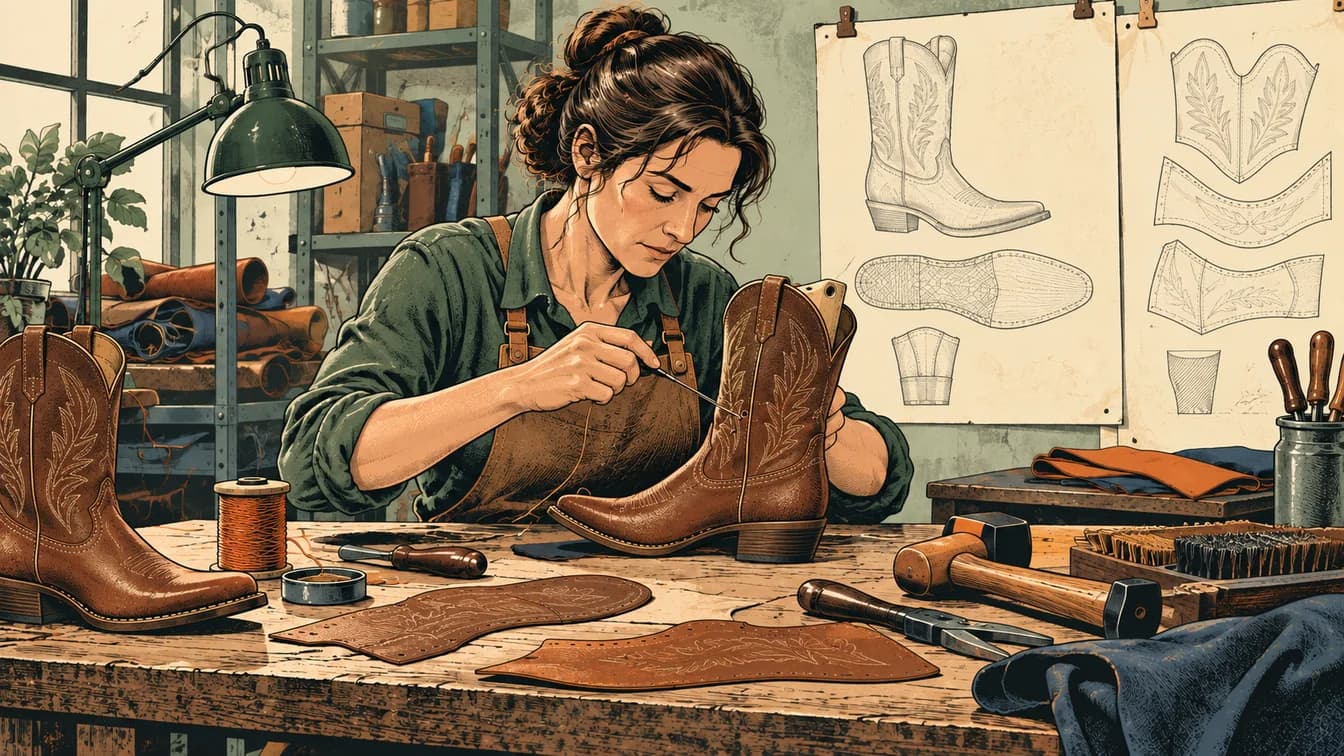
Where it fits
Pick your class- Physics 20 · B1 — forces and friction, with a design extension
How it works
Schematic · not to scale
A boot begins as pieces of material, but it has to work as a three-dimensional object.
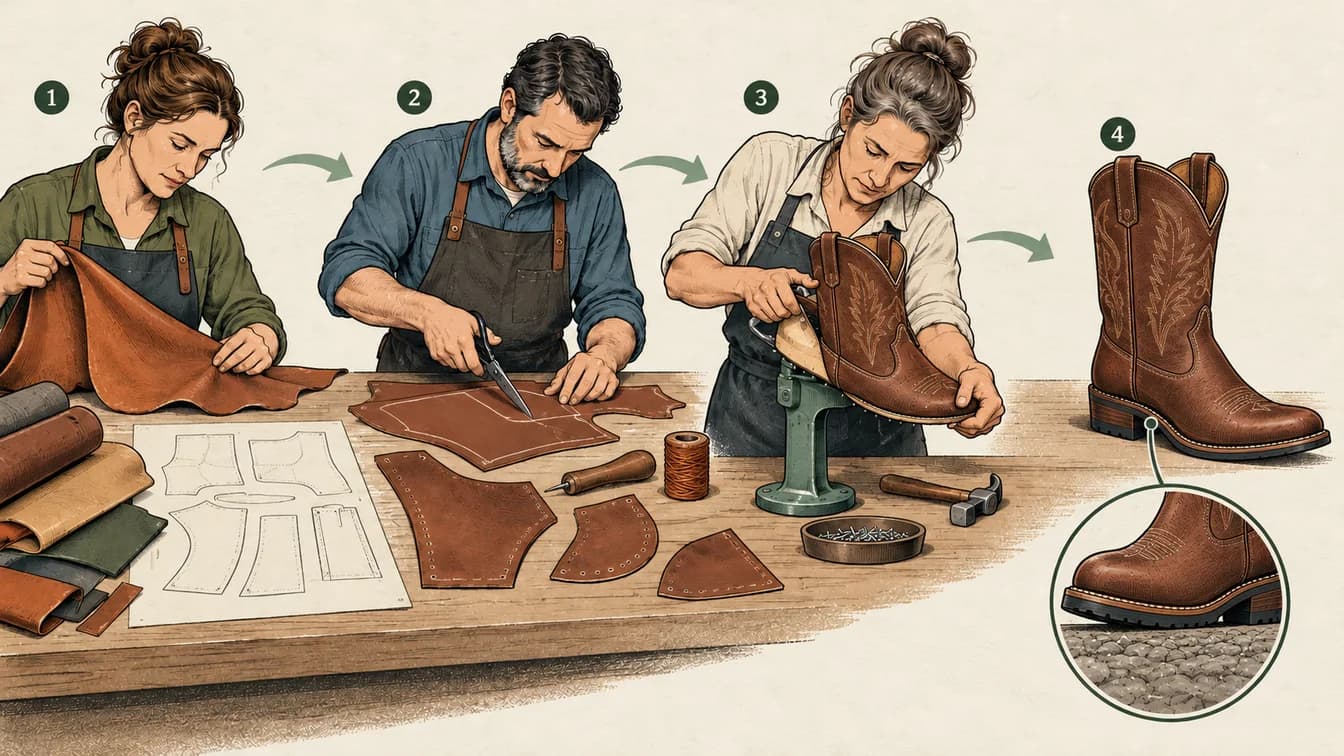
A maker selects materials and plans flat pieces that must work together.
Cutting and joining those pieces requires attention to how the material stretches and how parts align.
Lasting shapes the assembled upper around a form. A flat pattern must become a three-dimensional shape.
The finished boot has to balance fit, flexibility, appearance and contact with the ground. No single property is best for every intended use.
For the friction model compare the same surface and load; do not label a material universally 'grippier'. The actual company evidence supports craft and material decisions, not measured outsole performance.
The lesson, in the real world
A boot begins as pieces of material, but it has to work as a three-dimensional object.
- 1
A maker selects materials and plans flat pieces that must work together.
Our explanation - 2
Cutting and joining those pieces requires attention to how the material stretches and how parts align.
Our explanation - 3
Lasting shapes the assembled upper around a form. A flat pattern must become a three-dimensional shape.
Our explanation - 4
The finished boot has to balance fit, flexibility, appearance and contact with the ground. No single property is best for every intended use.
Our explanation
Who does this work
Role
Quality and traceability
Make it possible to explain how a result or product was produced. Quality work checks records, methods and acceptance criteria so variation can be investigated rather than hidden.
What might you actually do?
Investigate
Check that materials and samples have traceable identities.
Test and compare
Compare recorded results with defined acceptance criteria.
Explain and improve
Investigate deviations and document what changed.
Typical of this kind of work in general. Not a description of any one person’s job at Alberta Boot Company.
- Often works with
- Production, laboratory, engineering and customer teams
- Classroom connection
- Repeated results need both measurements and records of the conditions that produced them.
Related job postings
Similar work at other employers in Calgary, AB, not openings at Alberta Boot Company. These are live searches: results change daily and we have not checked them.
- Quality assurance technicianIndeed search for Quality assurance technician (opens in a new tab)Job Bank search for Quality assurance technician (opens in a new tab)
- Quality control analystIndeed search for Quality control analyst (opens in a new tab)Job Bank search for Quality control analyst (opens in a new tab)
How to prepare
Learning through retail and production experience
Alberta Boot Company
Fibre
Alberta University of the Arts
Ways in
For your students
Ways to prepare for this work
Programs that teach skills this work uses. Each is one route in, not a requirement, and no program has endorsed this page.
Showing routes for quality and traceability. Show all
Alberta Boot CompanyObserved individual routeCalgary
Learning through retail and production experience
An employer profile describes retail work during high school followed by growing production responsibilities.
About this route
One person's experience, not an advertised apprenticeship, vacancy or universal entry requirement. Check current admissions and intake before applying; this draft does not promise entry or employment.
Why it connects to the work · our interpretation
Quality and traceabilityAn employer profile describes retail work during high school followed by growing production responsibilities. A clear record makes a result checkable by someone who was not there.
Alberta University of the ArtsStudio concentration within degree studyCalgary
Fibre
Material exploration, textile techniques and design critique.
About this route
Adjacent material/design education, not an Alberta Boot training program or bootmaking certificate. Check current admissions and intake before applying; this draft does not promise entry or employment.
Why it connects to the work · our interpretation
Quality and traceabilityMaterial exploration, textile techniques and design critique. A clear record makes a result checkable by someone who was not there.
Ask the class
Use it in class
Ask the class
Which property would you refuse to sacrifice for your chosen use, and what trade-off would that create?
Give students two fictional outsole samples on the same horizontal surface with the same normal load. Compare the horizontal force just before sliding, then discuss why this test says little about comfort, fit or long-term wear. Treat this as a model, not Alberta Boot's testing procedure.
Mindset it shows
For the friction model compare the same surface and load; do not label a material universally 'grippier'. The actual company evidence supports craft and material decisions, not measured outsole performance.
About Alberta Boot Company

A boot begins as pieces of material, but it has to work as a three-dimensional object.
- Headquarters
- Headquarters not separately verified for this example.
- Local connection
- Own store and custom-boot pages identify Calgary factory/workshop and cutting, stitching, shaping and finishing.
- Source: albertaboot.ca — calgary(opens in a new tab); albertaboot.ca — custom boots(opens in a new tab); Alberta Boot Company — Learning through retail and production experience(opens in a new tab)
- Team size
- Not verified. We have not found a dated, sourced figure.
- The problem
- How do material and shape choices change the way a boot performs?
- Source: albertaboot.ca — calgary(opens in a new tab); albertaboot.ca — custom boots(opens in a new tab); Alberta Boot Company — Learning through retail and production experience(opens in a new tab)
- What they do
- Make boots from selected materials and component shapes.
- Source: albertaboot.ca — calgary(opens in a new tab); albertaboot.ca — custom boots(opens in a new tab); Alberta Boot Company — Learning through retail and production experience(opens in a new tab)
- Who uses it
- People choosing boots for personal use and the craftspeople translating a design into a wearable object.
- Source: albertaboot.ca — calgary(opens in a new tab); albertaboot.ca — custom boots(opens in a new tab); Alberta Boot Company — Learning through retail and production experience(opens in a new tab)
Alberta Boot Company handcrafts boots at a Calgary workshop connected to its flagship store. Its sources describe cutting, stitching, shaping and finishing, and a maker profile discusses material stretch and lasting. This story uses those choices to explore fit, flexibility and forces. Custom choices do not mean the company makes an individual mould of each customer's foot.
Source: albertaboot.ca — calgary(opens in a new tab); albertaboot.ca — custom boots(opens in a new tab); Alberta Boot Company — Learning through retail and production experience(opens in a new tab)Read each source’s date and scope: a documented role is not proof of a current vacancy or of where every position is based.
Reported as Alberta Boot Company states it. Alberta Boot Company has not reviewed or endorsed this page.
Sources and course fit
Sources checked 18 Oct 2026
Where it fits
- Physics 20 · B1 — forces and friction, with a design extension
Editorial mapping to published CBE course topics. Pending educator review. No outcome-code alignment is claimed.
Sources
- albertaboot.ca — calgary(opens in a new tab)
- albertaboot.ca — custom boots(opens in a new tab)
- Alberta Boot Company — Learning through retail and production experience(opens in a new tab)
- Alberta University of the Arts — Fibre(opens in a new tab)
- alberta.ca — edc physics20 30 performance standards.pdf(opens in a new tab)
Organization claims are reported as the organization states them. Alberta Boot Company has not reviewed or endorsed this page.
What we know, and how
| Type | Claim | How we know |
|---|---|---|
| work | Alberta Boot Company handcrafts boots at a Calgary workshop connected to its flagship store. Its sources describe cutting, stitching, shaping and finishing, and a maker profile discusses material stretch and lasting. This story uses those choices to explore fit, flexibility and forces. Custom choices do not mean the company makes an individual mould of each customer's foot.Source: albertaboot.ca — calgary; albertaboot.ca — custom boots; Alberta Boot Company — Learning through retail and production experience | Company-stated work with source limits preserved |
| local connection | Own store and custom-boot pages identify Calgary factory/workshop and cutting, stitching, shaping and finishing.Source: albertaboot.ca — calgary; albertaboot.ca — custom boots; Alberta Boot Company — Learning through retail and production experience | Source-backed Calgary connection |
| course fit | Performance standards describe friction as dependent on both contacting surfaces and support controlled measurements. Bootmaking is the design context; fit, leatherworking and material durability extend beyond the physics outcome.Source: alberta.ca — edc physics20 30 performance standards.pdf | Editorial application of source-checked curriculum concepts |
| limits | AUArts Fibre is adjacent material/design education, not bootmaker certification. Preserve the observed route as one example and do not invent a formal apprenticeship or current entry-level vacancy.Source: albertaboot.ca — calgary; albertaboot.ca — custom boots; Alberta Boot Company — Learning through retail and production experience | Scope of this example |
Solid green: the organization states it. Outlined: seen in a dated source. Dashed: our interpretation, not yet researched, or announced but not yet real.